

Introduction
Cloud computing has evolved from a technological convenience into the foundation of modern digital business. Nearly every industry—from finance and healthcare to retail and manufacturing—relies on cloud infrastructure to improve agility, reduce operational costs, and accelerate innovation.
As organizations continue their digital transformation journeys, cloud technologies are entering a new era defined by artificial intelligence, automation, edge computing, and increasingly sophisticated security frameworks. In 2026, businesses are no longer asking whether they should move to the cloud; they are focused on how to maximize value from increasingly intelligent and distributed cloud ecosystems.
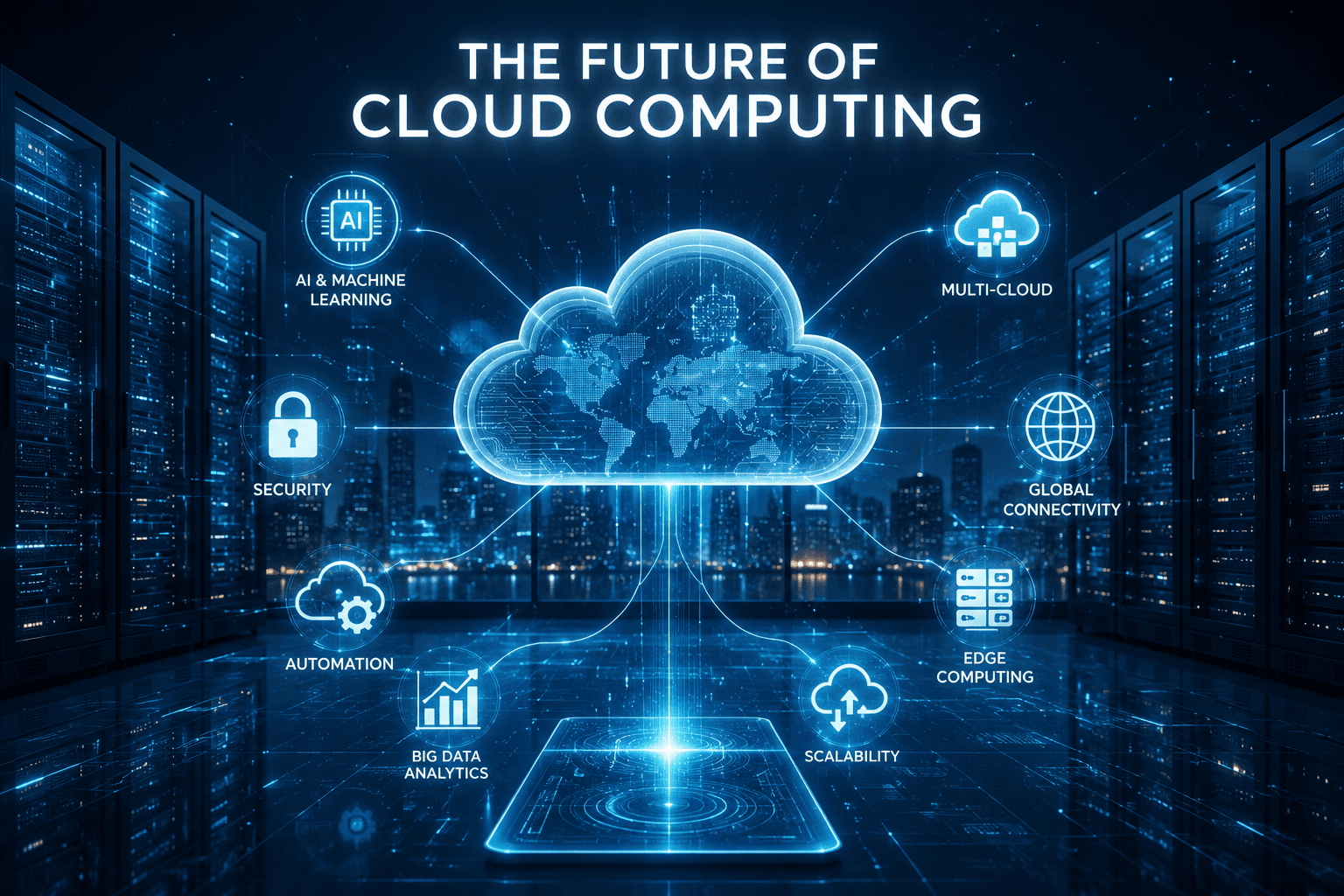
The Future of Cloud Computing is shaping a business landscape where applications become smarter, infrastructure becomes more autonomous, and data becomes more accessible than ever before. Organizations that understand these emerging trends will gain significant competitive advantages in productivity, customer experience, scalability, and innovation.
This comprehensive guide explores the most important cloud computing trends reshaping digital business in 2026 and beyond.
Understanding the Evolution of Cloud Computing
Cloud computing has undergone several major phases:
Phase 1: Infrastructure Modernization
Organizations migrated workloads from on-premises data centers to cloud platforms to reduce hardware costs and improve scalability.
Phase 2: Cloud-Native Development
Businesses adopted containers, microservices, and DevOps practices to accelerate software delivery.
Phase 3: Intelligent Cloud Ecosystems
Today, cloud environments are integrating artificial intelligence, automation, machine learning, and real-time analytics into core operations.
The next generation of cloud computing focuses on creating autonomous, secure, and highly adaptive digital ecosystems.
Why Cloud Computing Matters More Than Ever in 2026
Modern businesses face unprecedented challenges:
- Growing cybersecurity threats
- Rising customer expectations
- Massive data generation
- Global competition
- Rapid technological disruption
Cloud computing addresses these challenges by providing:
- Elastic scalability
- Cost efficiency
- Faster innovation cycles
- Enhanced collaboration
- Improved business continuity
- Access to advanced technologies
Industry analysts estimate that global cloud spending will continue reaching record levels as enterprises increase investments in AI-driven cloud infrastructure and digital transformation initiatives.
Top Cloud Computing Trends Reshaping Digital Business in 2026
AI-Powered Cloud Infrastructure
Artificial intelligence has become deeply integrated into cloud platforms.
Modern cloud providers now offer:
- Automated resource allocation
- Intelligent workload balancing
- Predictive maintenance
- AI-assisted security monitoring
- Autonomous infrastructure optimization
Benefits for Businesses
Organizations gain:
- Reduced operational costs
- Improved performance
- Better uptime
- Faster issue resolution
- Enhanced decision-making
AI-driven cloud management eliminates many manual administrative tasks, allowing IT teams to focus on strategic initiatives.
Rise of Multi-Cloud Strategies
Businesses increasingly avoid dependence on a single cloud provider.
A multi-cloud approach combines services from multiple platforms to improve flexibility and resilience.
Why Companies Choose Multi-Cloud
Benefits include:
- Reduced vendor lock-in
- Enhanced disaster recovery
- Better geographic coverage
- Cost optimization
- Improved compliance management
Organizations can select the best services from different providers while minimizing operational risks.
Common Multi-Cloud Use Cases
- Data storage on one platform
- AI services on another
- Application hosting elsewhere
This flexibility is becoming a major competitive advantage.
Hybrid Cloud Continues to Dominate Enterprise IT
Hybrid cloud combines public cloud services with private infrastructure.
Many organizations operate in highly regulated industries where complete migration to public cloud environments is not feasible.
Advantages of Hybrid Cloud
- Better compliance control
- Enhanced security
- Flexible workload placement
- Lower migration risk
- Improved operational efficiency
Hybrid environments provide a practical balance between innovation and control.
Edge Computing Expansion
As connected devices generate massive volumes of data, centralized cloud processing creates latency challenges.
Edge computing addresses this issue by processing data closer to its source.
Industries Benefiting from Edge Computing
Manufacturing
Real-time equipment monitoring improves productivity and reduces downtime.
Healthcare
Medical devices can process critical patient information instantly.
Retail
Smart stores leverage real-time analytics to improve customer experiences.
Transportation
Connected vehicles rely on immediate data processing for safety and efficiency.
Business Impact
Organizations benefit from:
- Faster response times
- Reduced bandwidth costs
- Improved customer experiences
- Enhanced operational intelligence
Serverless Computing Becomes Mainstream
Serverless computing allows developers to build applications without managing infrastructure.
Instead of provisioning servers, businesses pay only for the computing resources they consume.
Advantages
- Reduced operational complexity
- Faster development cycles
- Automatic scaling
- Lower infrastructure costs
- Improved agility
Popular Applications
- Event-driven systems
- APIs
- Data processing
- IoT applications
- AI workloads
Serverless architectures are becoming essential for organizations pursuing rapid innovation.
Cloud Security Evolves Beyond Traditional Models
Zero Trust Security Frameworks
Cybersecurity remains one of the most critical concerns for cloud adoption.
The traditional “trust but verify” approach is being replaced by Zero Trust architecture.
Core Principles
- Never trust automatically
- Verify every request
- Continuously monitor activity
- Restrict access based on risk
Benefits
- Reduced attack surfaces
- Improved compliance
- Stronger identity protection
- Better threat detection
Zero Trust is becoming the standard security model for cloud environments.
AI-Driven Cybersecurity
Modern cyberattacks are increasingly sophisticated.
Cloud security platforms now use artificial intelligence to:
- Detect anomalies
- Identify threats
- Predict attack patterns
- Automate incident responses
Organizations adopting AI-powered security tools can significantly reduce response times and improve overall protection.
Cloud Native Technologies Accelerate Innovation
Containers and Kubernetes Growth
Cloud-native development continues expanding rapidly.
Containers allow applications to run consistently across different environments.
Benefits
- Faster deployment
- Greater scalability
- Enhanced portability
- Improved resource utilization
Kubernetes remains the leading orchestration platform for managing containerized applications.
DevSecOps Integration
Security is no longer treated as a final development step.
DevSecOps integrates security throughout the software development lifecycle.
Advantages
- Earlier vulnerability detection
- Faster remediation
- Better compliance
- Reduced security risks
This approach aligns development, operations, and security teams around shared objectives.
Sustainable Cloud Computing Gains Momentum
Environmental sustainability is becoming a strategic priority.
Data centers consume significant amounts of energy, prompting cloud providers to invest heavily in green technologies.
Sustainability Initiatives
Leading cloud providers are implementing:
- Renewable energy programs
- Carbon reduction strategies
- Energy-efficient hardware
- Intelligent workload management
Business Benefits
Organizations gain:
- Lower environmental impact
- Stronger brand reputation
- Improved ESG performance
- Greater regulatory compliance
Green cloud computing is transitioning from a corporate responsibility initiative to a competitive differentiator.
Industry-Specific Cloud Innovation
Healthcare
Cloud computing enables:
- Telemedicine platforms
- AI-assisted diagnostics
- Electronic health records
- Secure patient data management
Financial Services
Banks leverage cloud technologies for:
- Fraud detection
- Real-time payments
- Risk analytics
- Regulatory compliance
Retail
Retailers use cloud platforms to:
- Personalize customer experiences
- Optimize inventory
- Enhance supply chains
- Support omnichannel commerce
Manufacturing
Manufacturers deploy cloud solutions for:
- Predictive maintenance
- Digital twins
- Smart factories
- Industrial IoT
Industry-specific cloud adoption is driving significant operational improvements across sectors.
The Role of Generative AI in Cloud Computing
Generative AI has become one of the most transformative technologies influencing cloud platforms.
Cloud providers increasingly offer integrated AI services that help organizations:
- Create content
- Generate code
- Automate workflows
- Analyze data
- Improve customer service
Business Advantages
Generative AI enables:
- Increased productivity
- Faster innovation
- Reduced operational costs
- Better customer engagement
The convergence of cloud computing and generative AI is creating entirely new business opportunities.
Challenges Businesses Must Prepare For
Despite significant advantages, organizations face several challenges.
Data Privacy Regulations
Businesses must comply with increasingly complex regulations governing data storage and processing.
Skills Shortages
Demand for cloud architects, cybersecurity professionals, and AI specialists continues to exceed supply.
Cost Management
Cloud spending can escalate rapidly without proper governance.
Recommended Strategies
- Monitor usage continuously
- Implement FinOps practices
- Optimize workloads
- Automate resource management
Organizations that proactively address these challenges will maximize cloud ROI.
Strategic Recommendations for Businesses in 2026
To remain competitive, organizations should:
1. Invest in AI-Enabled Cloud Platforms
AI-driven cloud environments improve efficiency and scalability.
2. Develop a Multi-Cloud Strategy
Diversification reduces risk and increases flexibility.
3. Prioritize Cybersecurity
Implement Zero Trust and AI-powered security solutions.
4. Adopt Cloud-Native Development
Containers and microservices improve agility.
5. Explore Edge Computing Opportunities
Real-time data processing creates significant business value.
6. Focus on Sustainability
Green cloud initiatives support long-term growth and compliance.
Frequently Asked Questions (FAQs)
What is the future of cloud computing in 2026?
The future of cloud computing includes AI-powered infrastructure, multi-cloud adoption, edge computing, enhanced cybersecurity, serverless architectures, and sustainable cloud operations.
Why is multi-cloud becoming popular?
Multi-cloud strategies reduce vendor lock-in, improve resilience, enhance flexibility, and allow businesses to optimize costs across providers.
How does AI impact cloud computing?
AI automates infrastructure management, improves security, enhances analytics, and enables predictive resource optimization.
What is edge computing?
Edge computing processes data closer to its source rather than relying solely on centralized cloud servers, reducing latency and improving performance.
Is cloud computing secure in 2026?
Yes. Modern cloud environments use advanced security technologies such as Zero Trust frameworks, AI-powered threat detection, encryption, and identity management systems.
What industries benefit most from cloud computing?
Healthcare, finance, retail, manufacturing, logistics, education, and technology sectors are among the largest beneficiaries of cloud innovation.
What is serverless computing?
Serverless computing allows developers to build applications without managing servers, enabling automatic scaling and pay-per-use pricing.
How can businesses reduce cloud costs?
Organizations can implement FinOps practices, optimize workloads, monitor resource utilization, and automate infrastructure management.
Conclusion
The future of cloud computing in 2026 extends far beyond infrastructure hosting. It is becoming the intelligent backbone of modern business, enabling unprecedented levels of automation, innovation, agility, and scalability. Emerging technologies such as Artificial Intelligence & Intelligent Systems, edge computing, multi-cloud architectures, serverless computing, and advanced cybersecurity frameworks are fundamentally transforming how organizations operate and compete.
Businesses that embrace these trends early will be better positioned to adapt to market changes, improve operational efficiency, and deliver superior customer experiences. Success will depend not only on cloud adoption but also on strategic implementation, governance, security, and continuous innovation.
Organizations should begin preparing today by investing in cloud-native technologies, strengthening cybersecurity capabilities, leveraging AI-driven solutions, and developing long-term cloud transformation roadmaps. The companies that act decisively will define the next generation of digital leadership.