

Introduction
Most websites don’t struggle because they publish too little content—they struggle because they publish content without a scalable strategy.
Every day, businesses invest countless hours writing articles they hope will rank. Some attract a few visitors, while many never generate meaningful traffic. The difference isn’t always writing quality. More often, it’s the system behind the content.
Imagine if your website could answer hundreds or even thousands of highly specific search queries without sacrificing quality. Instead of competing for one broad keyword, you could build an organized library of pages that solve real problems for different audiences. That’s exactly what Programmatic SEO is designed to achieve.
But here’s where many website owners get it wrong.
Some believe programmatic SEO is simply publishing thousands of AI-generated pages. Others think it’s a shortcut to overnight rankings. In reality, both approaches usually fail because they prioritize volume over value.
Successful programmatic SEO… strengthens topical authority across your website. To understand this concept in greater depth, read our Topical Authority Blueprint guide.
Whether you run a SaaS business, an eCommerce store, a marketplace, a local directory, or a growing content website, programmatic SEO can help you expand your organic reach—provided every page exists to solve a real user problem.
In this guide, you’ll learn how programmatic SEO works, when it makes sense to use it, how to avoid common mistakes, and how to build a strategy that supports long-term organic growth instead of chasing short-term rankings.
What Is Programmatic SEO?

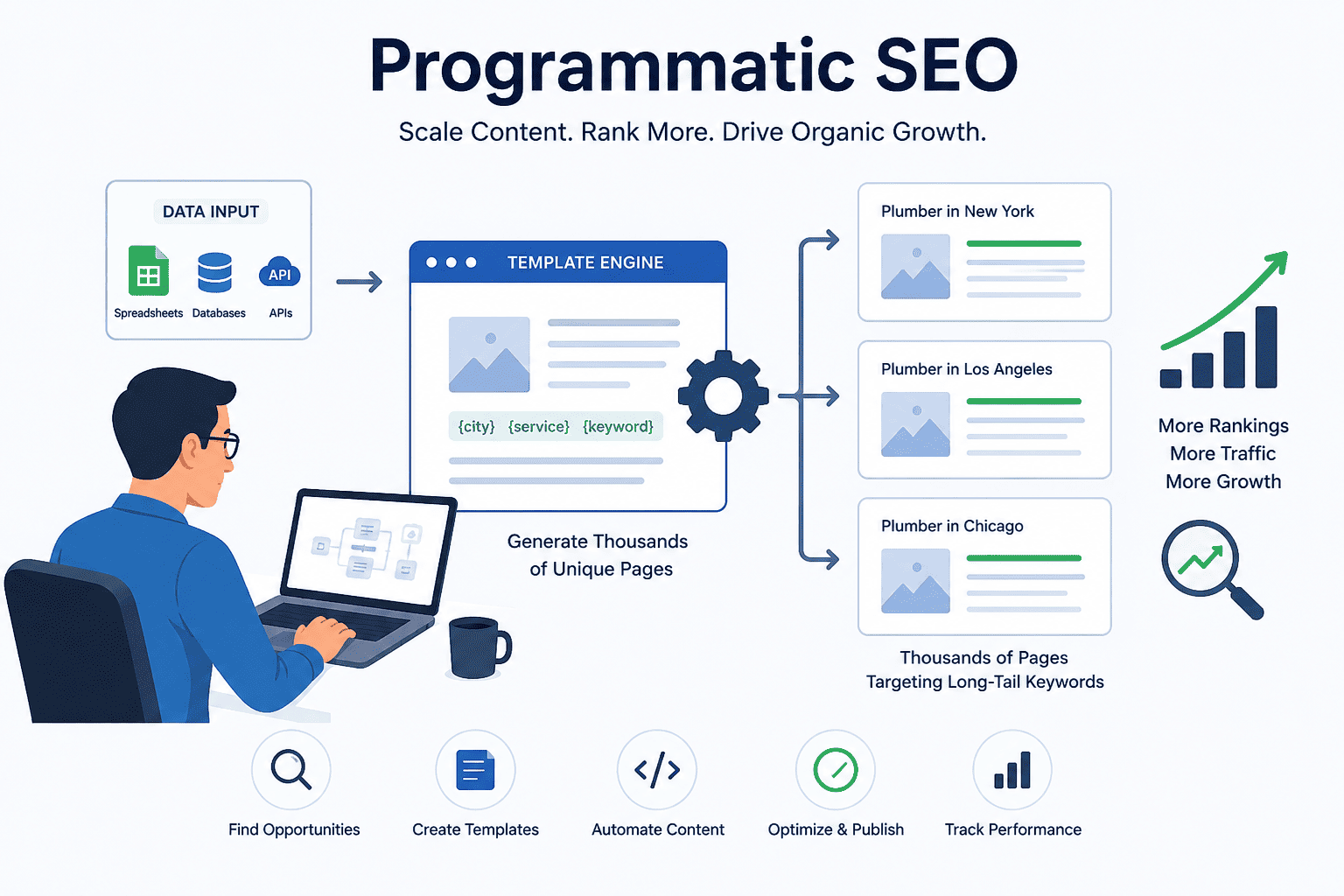
Programmatic SEO is a content strategy that uses structured data, reusable page templates, and editorial workflows to create large numbers of high-quality pages that target specific search intent.
The goal isn’t to produce more pages for the sake of numbers. The goal is to create a scalable system where every page answers a unique question or helps users make a better decision.
Think of it this way:
A traditional SEO strategy might publish one article titled:
Best CRM Software
A programmatic SEO strategy expands that topic into multiple useful resources such as:
- Best CRM Software for Small Businesses
- Best CRM Software for Healthcare Providers
- Best CRM Software for Real Estate Agencies
- Best CRM Software for Marketing Teams
- Best CRM Software for Startups
- Best CRM Software with AI Features
Each page targets a different audience with different needs. Instead of repeating the same content, every page explains why certain solutions fit that specific use case.
That is the real purpose of programmatic SEO: matching search intent with meaningful, scalable content.
Why Programmatic SEO Is Becoming More Important
Search behavior has changed.
People no longer search using only broad keywords. Instead, they ask highly specific questions because they expect highly specific answers.
Compare these two searches:
Broad Search
Best Accounting Software
Specific Search
Best Accounting Software for Freelancers with International Clients
The second query reveals much stronger intent.
The user already knows what they need. They simply want the best solution for their situation.
Programmatic SEO allows websites to serve thousands of these highly targeted searches without creating each page entirely from scratch.
As search engines become better at understanding context, entities, and relationships between topics, learning Semantic SEO and Entity SEO can help you build stronger topical relevance.
The Foundation of Successful Programmatic SEO
Many people think automation is the secret.
It isn’t.
The real foundation is understanding users.
Before creating a single page, ask yourself:
- What question is the visitor trying to answer?
- What decision are they trying to make?
- What information would genuinely help them?
- Can this page provide value that generic content cannot?
If you can’t answer these questions, the page probably shouldn’t exist.
Successful programmatic SEO starts with user intent—not templates.
The SMART Scale Framework™

One of the easiest ways to understand programmatic SEO is through the SMART Scale Framework, a practical model designed to keep quality at the center of every stage.
S — Search Intent First
Understanding search intent also helps modern AI-powered search systems interpret content more accurately. GEO vs Traditional SEO
Instead of chasing high-volume keywords, identify search patterns that reveal real needs.
M — Meaningful Content
Templates save time, but they should never replace thoughtful writing.
Every page should include useful explanations, practical advice, and information that is specific to the topic.
A — Authority Signals
Strong authority signals are built through expertise, accurate information, structured content, and clear editorial practices. E-E-A-T SEO Guide 2026
.
R — Repeatable Systems
Rather than creating every page manually, develop workflows that maintain quality while making growth more efficient.
Scalability should never reduce usefulness.
T — Track and Improve
Publishing isn’t the finish line.
Monitor performance, identify what works, update successful pages, and continuously improve your content based on real user behavior.
This ongoing process is what separates sustainable SEO strategies from short-lived growth.
How Programmatic SEO Actually Works
Behind every successful programmatic SEO project is a repeatable workflow.
Step 1: Discover Repeatable Search Patterns
Instead of collecting random keywords, identify search structures that repeat naturally.
Examples include:
- Best CRM Software for Industry
- AI Tools for Profession
- Payroll Software for Country
- SEO Agency in City
- Accounting Software for Business Type
Each pattern creates opportunities to build many useful pages while maintaining a logical structure.
Step 2: Organize Reliable Data
High-quality pages depend on high-quality information.
Depending on your niche, your database might include:
- Products
- Features
- Pricing
- Industries
- Locations
- Integrations
- Categories
- Customer reviews
- Business types
Accurate data is what transforms templates into valuable resources.
Step 3: Build Flexible Templates
Templates provide consistency—not duplication.
A strong template may include:
- Introduction
- Overview
- Key Features
- Benefits
- Limitations
- Comparison Table
- Frequently Asked Questions
- Internal Links
- Call to Action
The layout remains consistent, while the content adapts to each specific search intent.
Step 4: Add Human Expertise
Automation can organize information.
Only thoughtful writing creates trust.
Before publishing any page, ask:
- Does this explain something useful?
- Does it answer the user’s likely questions?
- Does it include practical recommendations?
- Would someone bookmark or share this page?
If the answer is yes, you’re creating value—not just content.
Expert Insight
One of the biggest mistakes in programmatic SEO is assuming that scaling content automatically leads to scaling traffic.
In reality, search engines reward pages that solve problems—not pages that simply exist.
A website with 200 exceptional pages often builds more authority than a website with 5,000 repetitive pages. The objective isn’t to become the biggest publisher in your niche. The objective is to become the most useful.
Quick Action Checklist
Before moving to the next stage of your strategy, make sure you can answer Yes to each question:
- Do I understand the user’s search intent?
- Do I have accurate and structured data?
- Can every page offer unique value?
- Is my template flexible enough to avoid repetition?
- Does each page help users make better decisions?
If the answer is No to any of these questions, improve the foundation before scaling.
What’s Next?
Now that you understand the principles behind programmatic SEO, the next step is learning how to discover scalable keyword opportunities, build templates that remain unique, and create content that earns trust instead of becoming another collection of thin pages.
Programmatic SEO Guide (Part 2)
Finding Keyword Opportunities That Actually Matter
One of the biggest mistakes in programmatic SEO is chasing keywords simply because they have search volume. High traffic numbers may look attractive, but they don’t always translate into meaningful visitors or business growth.
Instead of asking, “Which keyword has the highest volume?”, ask:
“Which searches represent a real problem that my website can solve better than anyone else?”
That shift in thinking changes everything.
Successful programmatic SEO begins with identifying repeatable search patterns backed by genuine user intent. When people repeatedly search for the same type of information with different variables—such as industries, locations, product types, or use cases—you’ve found an opportunity to build scalable content.
For example:
- Best CRM Software for Industry
- Payroll Software for Country
- AI Writing Tools for Profession
- SEO Agency in City
- Project Management Software for Team Size
These aren’t just keywords. They’re content systems capable of supporting hundreds of high-value pages.
The Intent-First Method™
Before creating a template, understand why someone is searching.
Every keyword belongs to an intent category.
Informational Intent
The visitor wants to learn.
Examples:
- What is Programmatic SEO?
- How does Semantic SEO work?
- What is Entity SEO?
Your goal is to educate clearly and build trust.
Commercial Intent
The visitor is comparing solutions before making a decision.
Examples:
- Best AI SEO Tools
- Best CRM Software for Startups
- Top Email Marketing Platforms
Your goal is to help users evaluate options honestly.
Transactional Intent
The visitor is ready to take action.
Examples:
- Buy CRM Software
- SEO Audit Service
- Start Free Trial
These pages should make the next step obvious without feeling pushy.
Navigational Intent
The visitor already knows where they want to go.
Examples:
- HubSpot Pricing
- Ahrefs Login
- Google Search Console
These searches usually don’t require programmatic content unless your website offers additional value.
Build Keyword Clusters, Not Keyword Lists
Traditional SEO often starts with a spreadsheet full of disconnected keywords.
Programmatic SEO works differently.
Instead of random keywords, create topic clusters around one core subject.
Example:
Main Topic: CRM Software
Supporting Clusters:
- CRM for Healthcare
- CRM for Real Estate
- CRM for Agencies
- CRM for Law Firms
- CRM for Startups
- CRM for Nonprofits
- CRM with AI
- CRM Pricing
- CRM Integrations
This structure helps search engines understand the depth of your coverage while making it easier for users to explore related topics.
The VALUE Framework™
To decide whether a keyword deserves its own page, use the VALUE Framework, created specifically for evaluating scalable SEO opportunities.
V — Valuable
Does the search represent a real problem or decision?
A — Addressable
Can you create content that genuinely answers the query better than existing results?
L — Logical
Does the keyword fit naturally within your site’s topical structure?
U — Unique
Can this page offer something different from hundreds of similar pages already ranking?
E — Expandable
Can the keyword become part of a larger content ecosystem?
If the answer is “yes” to all five questions, you’ve likely found a strong programmatic opportunity.
Designing Templates That Don’t Feel Like Templates
A common misconception is that templates make every page identical.
They shouldn’t.
Think of your template as the framework of a house. Every home follows the same engineering principles, but each one serves different people with different needs.
A high-quality template may include:
- Contextual introduction
- Problem overview
- Key considerations
- Feature comparison
- Practical recommendations
- Frequently asked questions
- Related resources
- Call to action
What changes is the depth, examples, and advice based on the audience.
For instance, a page targeting CRM Software for Dentists should discuss appointment scheduling, patient communication, and privacy considerations. A page targeting CRM Software for Construction Companies should focus on project tracking, contractor management, and mobile accessibility.
The structure remains familiar, but the experience becomes unique.
Add Human Context to Every Page
Data alone rarely earns trust.
Readers want explanations that help them understand why something matters.
Instead of listing software features, explain how those features solve real-world problems.
For example:
Rather than saying:
Supports automation.
Explain:
Automation can reduce repetitive administrative tasks, allowing teams to spend more time serving customers and less time managing routine workflows.
Small contextual insights make content feel more useful and more human.
Avoid the Thin Content Trap
Scaling content should never mean scaling repetition.
Thin content usually appears when pages:
- Repeat the same introduction.
- Change only one keyword.
- Offer little practical advice.
- Lack of comparisons.
- Ignore search intent.
- Provide no unique perspective.
Before publishing, ask yourself:
If someone lands on this page, will they learn something they couldn’t easily find elsewhere?
If the answer is no, improve the content before it goes live.
Internal Linking: Building a Content Ecosystem

Internal links do much more than help users navigate.
They show search engines how topics connect.
Think of your website as a city.
Every page is a building.
Internal links are the roads connecting them.
A city with well-planned roads is easier to explore than one filled with isolated buildings.
Your website should work the same way.
A strong structure looks like this:
Pillar Guide
↓
Supporting Guides
↓
Industry Pages
↓
Comparison Pages
↓
Individual Resources
Every page should naturally connect to broader and more specific topics, creating a seamless learning experience.
Expert Insight
One of the easiest ways to identify weak programmatic pages is to remove the keyword from the title.
If the article still provides useful advice that could help someone make a better decision, you’ve likely created meaningful content.
If removing the keyword leaves an empty shell with generic information, the page needs more work.
Great programmatic SEO isn’t built on templates.
It’s built on expertise delivered consistently through templates.
Quick Implementation Checklist
Before creating your first scalable content system, make sure you have:
- A repeatable keyword pattern
- Clear search intent
- Reliable data sources
- Flexible page templates
- Original editorial guidelines
- Internal linking strategy
- Content review process
- Performance tracking plan
These foundations make scaling far easier—and far more sustainable.
Transition to Part 3
You now know how to identify scalable keyword opportunities and create templates that maintain quality.
The next challenge is making sure search engines can efficiently crawl, understand, and trust those pages.
Programmatic SEO Guide (Part 3)
Build a Website That Can Scale
Creating hundreds of high-quality pages is only half the challenge. The other half is making sure search engines can discover, understand, and trust those pages efficiently.
Many websites invest months into producing content but overlook the technical foundation that supports it. As the number of pages grows, even small technical issues can become significant obstacles. Slow loading times, confusing site structures, duplicate URLs, or weak internal linking can limit the visibility of otherwise valuable content.
Successful programmatic SEO isn’t built on content alone—it’s built on a website architecture that can scale without creating unnecessary complexity.
Design Your Site Like a Library, Not a Warehouse
Imagine walking into a well-organized library.
Every book belongs to a category.
Every category leads to more specific sections.
Finding information feels effortless.
Now imagine a warehouse where books are scattered randomly across shelves. Even valuable books become difficult to find.
Your website should always resemble the first example.
A clear structure benefits both visitors and search engines.
A simple hierarchy might look like this:
Homepage
│
├── SEO
│ ├── Technical SEO
│ ├── Programmatic SEO
│ ├── Entity SEO
│ └── Semantic SEO
│
├── AI Tools
│ ├── AI Writing
│ ├── AI Automation
│ └── AI Search
│
└── SaaS Reviews
├── CRM Software
├── Project Management
└── Email Marketing
As your content grows, this structure helps users explore naturally while allowing search engines to understand topical relationships.
Build Topic Clusters Instead of Isolated Pages
Publishing standalone articles creates isolated knowledge.
Building topic clusters creates authority.
Think of a pillar article as the central hub.
Supporting articles answer narrower questions that naturally connect back to the main guide.
For example:
Programmatic SEO Guide
↓
Keyword Research
↓
Template Design
↓
Schema Markup
↓
Internal Linking
↓
Performance Tracking
This interconnected structure helps readers continue learning while reinforcing your expertise across the topic.
Improve Crawl Efficiency
Also make sure your robots.txt file allows important search crawlers to access valuable content. Robots.txt AI Crawling Guide
Good practices include:
- Keep important pages within a few clicks of the homepage.
- Remove broken links promptly.
- Avoid creating unnecessary duplicate URLs.
- Link new pages from relevant existing content.
- Keep navigation consistent across templates.
- Update XML sitemaps when new pages are published.
After publishing new pages, monitor indexing and crawl status with Google Search Console. For a complete walkthrough, read our Google Search Console Guide.
Use Structured Data to Improve Understanding
Structured data works even better when combined with strong semantic relationships between pages. Semantic SEO Guide
Depending on the page type, useful structured data may include:
- Article
- FAQ
- Breadcrumb
- Organization
- Product
- Review
- SoftwareApplication
- LocalBusiness
- ItemList
Structured data doesn’t guarantee rich results, but it helps search engines understand your content more accurately.
Speed Is Part of User Experience
Visitors expect pages to load quickly.
A slow page interrupts the experience before users even begin reading.
Improving performance often includes:
- Compressing images
- Using modern image formats where appropriate
- Reducing unnecessary scripts
- Loading resources efficiently
- Minimizing layout shifts
- Optimizing mobile performance
Fast websites encourage visitors to stay longer, explore additional content, and return in the future.
Create an Internal Linking System That Guides Readers
Internal links shouldn’t feel random.
Each link should answer the reader’s next logical question.
For example:
If someone is reading about Programmatic SEO, they may also benefit from learning about:
- Technical SEO
- Semantic SEO
- Entity SEO
- Internal Linking
- Topical Authority
- Structured Data
This creates a natural learning path instead of leaving readers at a dead end.
When planning internal links, think like a teacher organizing lessons—not like a machine inserting keywords.
Balance Automation with Editorial Review
Automation can save time, but it should never replace editorial judgment.
Use automation to handle repetitive tasks such as:
- Organizing structured data
- Generating page drafts
- Updating metadata
- Managing content inventories
- Monitoring performance
Reserve human expertise for:
- Explaining complex ideas
- Reviewing accuracy
- Improving clarity
- Adding practical insights
- Ensuring every page serves a real purpose
The strongest programmatic SEO strategies combine efficiency with thoughtful editing.
Measure What Matters
Publishing more pages isn’t the goal.
Creating pages that perform is.
Monitor metrics such as:
- Organic traffic growth
- Indexed pages
- Click-through rate (CTR)
- Average engagement time
- Conversion rate
- Returning visitors
- Crawl errors
- Internal link coverage
Reviewing these metrics regularly helps identify successful templates and pages that need improvement.
The CONTINUOUS Growth Model™
Programmatic SEO is not a one-time project. It is an ongoing process of learning and improvement.
A practical cycle looks like this:
C — Create
Publish useful pages based on real search intent.
O — Observe
Track how users and search engines interact with the content.
N — Notice Patterns
Identify which topics, templates, and page types perform best.
T — Test Improvements
Update headlines, introductions, comparisons, and internal links where appropriate.
I — Improve
Refresh outdated information, strengthen weak sections, and expand useful content.
N — Nurture Authority
Continue building related content that reinforces topical expertise.
U — Understand Users
Use search behavior and feedback to guide future content decisions.
O — Optimize
Refine technical SEO, improve performance, and maintain content quality.
U — Update
Keep information current as industries, products, and best practices evolve.
S — Scale
Only expand successful systems after they’ve demonstrated value.
Expert Insight
Many websites try to scale first and optimize later.
The most successful publishers do the opposite.
They perfect a small system, measure real performance, improve it continuously, and only then expand it across hundreds of pages.
Scaling a weak process simply creates more weak pages.
Scaling a proven process creates long-term growth.
Action Checklist
Before publishing a large number of programmatic pages, confirm that you have:
- A clear site architecture
- Topic clusters connected through internal links
- Optimized page speed
- Accurate structured data
- XML sitemaps
- Editorial review guidelines
- Performance tracking in place
- A plan for regular content updates
If these foundations are in place, your website is far better prepared for sustainable growth.
Common Programmatic SEO Mistakes That Limit Growth
Programmatic SEO can become one of the most effective organic growth strategies available—but only when it’s implemented thoughtfully. Many projects fail not because the idea is flawed, but because execution focuses on scale before quality.
Understanding these common mistakes will help you build a system that supports long-term growth instead of short-term gains.
Mistake #1: Treating Every Keyword as a Separate Opportunity
Not every keyword deserves its own page.
If several keywords share the same search intent, combining them into one comprehensive resource often creates a better user experience than publishing multiple thin pages.
Before creating a new page, ask:
- Does this query solve a different problem?
- Would users expect unique information?
- Can I add meaningful value beyond existing pages?
If the answer is no, expanding an existing page may be the smarter choice.
Mistake #2: Creating Templates Without Context
Templates improve efficiency, but they should never replace expertise.
A page about CRM Software for Dentists should discuss appointment workflows, patient communication, and privacy considerations.
A page about CRM Software for Real Estate should focus on lead management, property pipelines, and client follow-ups.
The structure may stay consistent, but the advice should reflect the audience’s real-world needs.
Mistake #3: Ignoring Content Maintenance
Publishing is only the beginning.
Products evolve.
Industries change.
Search behavior shifts.
A page that performed well last year may become outdated if it isn’t reviewed regularly.
Schedule periodic updates to:
- Refresh examples
- Improve explanations
- Add new comparisons
- Update pricing where relevant
- Expand FAQs
- Improve internal links
Consistent maintenance helps preserve both accuracy and usefulness.
Mistake #4: Weak Internal Connections
Pages should support each other rather than compete.
Every new article should naturally connect to:
- A broader pillar page
- Closely related guides
- Supporting resources
- Relevant comparison articles
This creates a stronger topical ecosystem and helps readers continue their journey.
Mistake #5: Measuring the Wrong Success Metrics
Publishing 1,000 pages sounds impressive.
Helping 1,000 people solve meaningful problems is even more valuable.
Instead of focusing only on page count, evaluate:
- Organic traffic quality
- Engagement time
- Conversions
- Returning visitors
- Topic coverage
- Content freshness
- User satisfaction
Sustainable SEO success comes from continuous improvement—not simply increasing content volume.
A Practical Programmatic SEO Roadmap
If you’re starting from scratch, don’t try to build thousands of pages immediately.
A phased approach is more effective.
Phase 1 — Build the Foundation
- Choose one core topic.
- Research search intent.
- Collect reliable data.
- Design one flexible template.
Your goal is to create a repeatable system—not a massive content library.
Phase 2 — Publish a Small Batch
Launch 20–50 carefully reviewed pages.
Watch how users interact with them.
Study which sections keep visitors engaged and which areas need improvement.
Phase 3 — Optimize Before Scaling
Improve your templates based on real performance.
Strengthen introductions.
Expand useful sections.
Improve internal links.
Update metadata where needed.
Small improvements made early often produce larger gains later.
Phase 4 — Scale Gradually
Once your workflow consistently produces valuable pages, expand into additional industries, locations, or categories.
Scaling should be the reward for quality—not a replacement for it.
Frequently Asked Questions
Is Programmatic SEO suitable for every website?
No.
Programmatic SEO works best when your website has structured information that can be presented in multiple useful ways. Businesses with directories, SaaS products, marketplaces, travel content, comparison sites, and educational resources often benefit the most.
Can small websites use Programmatic SEO?
Yes.
You don’t need thousands of pages to benefit.
Many successful websites begin with a few dozen high-quality programmatic pages and expand gradually as they learn what works for their audience.
Will AI replace Programmatic SEO?
AI can improve efficiency by assisting with research, organization, and drafting.
However, useful content still depends on human judgment, editorial review, and a clear understanding of user needs.
Automation supports quality—it does not replace it.
How many pages should I publish?
There is no universal number.
Start with enough pages to test your system, evaluate performance, and refine your workflow before expanding further.
Quality should always determine the pace of growth.
How long does Programmatic SEO take to show results?
SEO timelines vary depending on your website’s authority, competition, technical health, and content quality.
Rather than expecting instant results, focus on building a consistent process that improves over time. Strong systems typically outperform rushed publishing strategies in the long run.
Key Takeaways
Programmatic SEO succeeds when it combines strategy with execution.
Remember these principles:
- Build around search intent, not keywords alone.
- Create systems that maintain quality as you scale.
- Use templates to organize information, not duplicate it.
- Connect pages through meaningful internal links.
- Review and improve content regularly.
- Let user value guide every publishing decision.
When these elements work together, your website becomes easier to navigate, easier to understand, and more useful for both visitors and search engines.
Final Thoughts
Programmatic SEO is not about producing the highest number of pages.
It’s about building a content system that consistently delivers the right information to the right audience at the right time.
The websites that succeed over the long term are rarely those that publish the fastest. They are the ones that understand their audience, organize information clearly, maintain high editorial standards, and improve continuously.
Whether you’re growing a SaaS platform, a content publication, an eCommerce business, or a niche directory, the same principle applies:
Scale only after you’ve proven quality.
That mindset creates stronger topical authority, a better user experience, and a more sustainable foundation for organic growth.
Conclusion
Programmatic SEO is a long-term investment in building a smarter content ecosystem—not a shortcut to search rankings.
By combining thoughtful keyword research, structured data, flexible templates, technical excellence, and continuous optimization, you can create pages that genuinely help users while supporting sustainable organic growth.
The most effective programmatic SEO strategies are built on consistency, relevance, and trust. Instead of asking, “How many pages can we publish?”, ask, “How many useful problems can we solve?” That simple shift in perspective often makes the difference between a content library that grows with time and one that is forgotten.
As your website grows, continue strengthening topical authority, semantic relationships, and technical SEO to support long-term organic visibility. Topical Authority Blueprint + Semantic SEO Guide + E-E-A-T SEO Guide
Ready to take the next step? Apply the frameworks in this guide, measure your results, improve what works, and expand only when your process consistently delivers value. Sustainable SEO success is built one helpful page at a time.