

Introduction
In today’s hyper-competitive digital economy, businesses face constant pressure to grow quickly while keeping operational costs under control. Traditional IT infrastructure often creates a significant challenge: companies must invest heavily in servers, storage systems, networking equipment, software licenses, and dedicated IT teams long before they can fully utilize those resources.
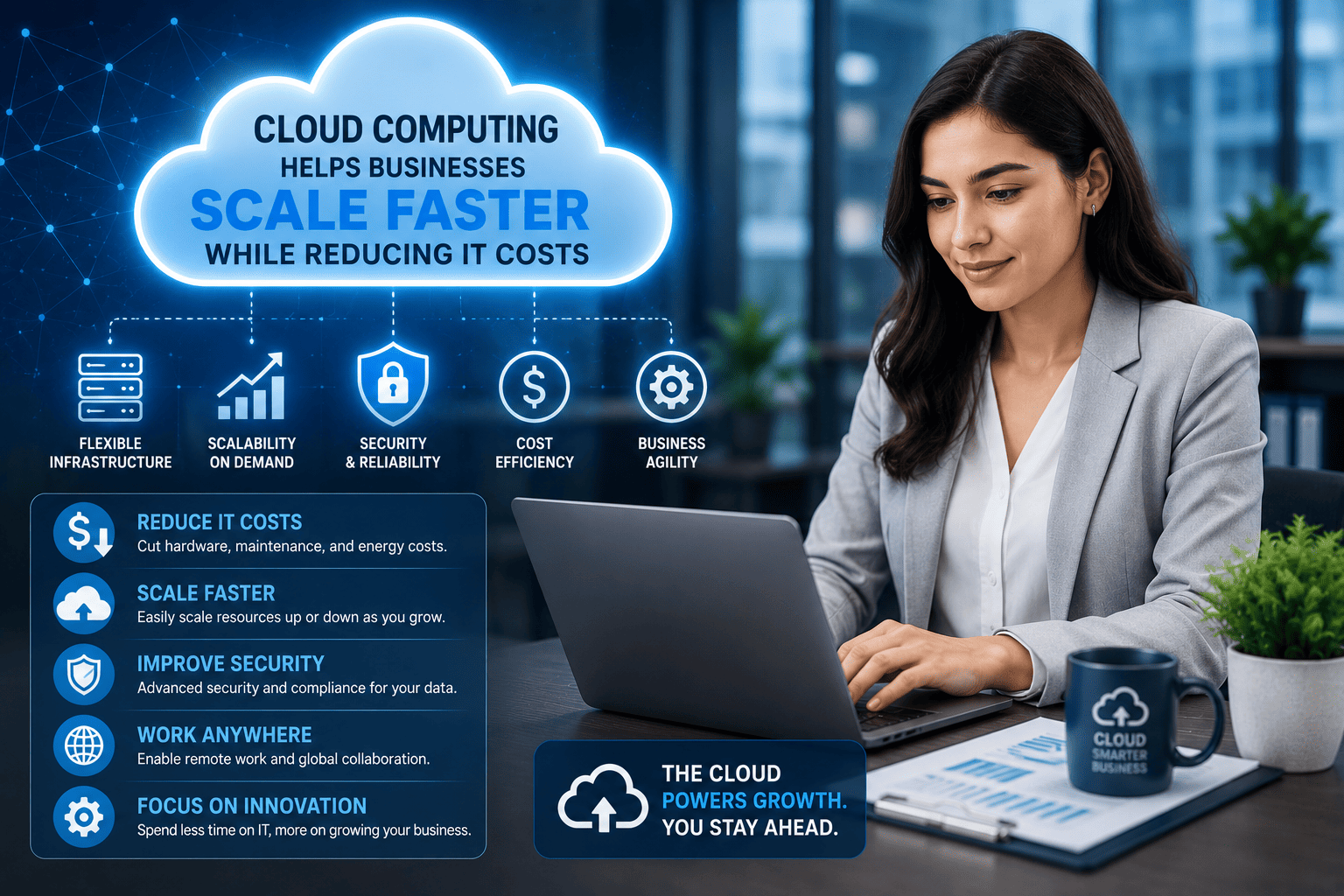
Cloud computing benefits has fundamentally changed this model.
Instead of purchasing and maintaining expensive infrastructure, organizations can access computing resources on demand, paying only for what they use. This shift enables businesses to scale operations rapidly, launch products faster, improve flexibility, and significantly reduce IT expenditures.
From startups seeking rapid growth to multinational enterprises managing global operations, cloud computing has become a critical component of modern business strategy. According to industry estimates, worldwide spending on public cloud services continues to grow annually as organizations increasingly recognize the financial and operational advantages of cloud adoption.
Businesses planning long-term digital transformation strategies should also explore the latest developments shaping the industry in our guide on Future of Cloud Computing Trends in 2026
Understanding Cloud Computing
What Is Cloud Computing?
Cloud computing refers to the delivery of computing services over the internet. These services include:
- Servers
- Storage
- Databases
- Networking
- Software
- Analytics
- Artificial Intelligence
- Security tools
Instead of hosting applications and data on local hardware, organizations access these resources through cloud service providers.
Core Cloud Service Models
Infrastructure as a Service (IaaS)
Provides virtualized computing resources such as:
- Virtual machines
- Storage
- Networking
- Operating systems
Examples include virtual cloud servers and scalable storage platforms.
Platform as a Service (PaaS)
Offers development environments that enable businesses to build, test, and deploy applications without managing underlying infrastructure.
Software as a Service (SaaS)
Delivers software applications through web browsers, eliminating installation and maintenance requirements.
Examples include:
- Customer relationship management systems
- Collaboration tools
- Productivity software
- Business intelligence platforms
Why Scalability Matters for Modern Businesses
Business growth is rarely predictable.
A company may experience:
- Seasonal demand spikes
- Viral marketing success
- Rapid customer acquisition
- Geographic expansion
- New product launches
Traditional infrastructure struggles to accommodate sudden changes.
Organizations often face two costly scenarios:
Under-Provisioning
Insufficient infrastructure causes:
- Website crashes
- Performance issues
- Customer dissatisfaction
- Revenue losses
Over-Provisioning
Excess infrastructure leads to:
- Wasted investments
- Higher maintenance costs
- Inefficient resource utilization
Cloud computing solves both problems through dynamic scalability.
How Cloud Computing Enables Faster Business Scaling
1. Instant Access to Computing Resources
One of the biggest advantages of cloud technology is on-demand resource provisioning.
Businesses can deploy:
- Additional servers
- Storage capacity
- Database resources
- Network bandwidth
within minutes rather than weeks or months.
Traditional Infrastructure Timeline
A typical hardware deployment may require:
- Budget approval
- Vendor selection
- Hardware procurement
- Shipping
- Installation
- Configuration
- Testing
This process can take several months.
Cloud Deployment Timeline
Cloud resources can often be provisioned in minutes through a management dashboard or automated scripts.
This speed allows businesses to respond immediately to changing market conditions.
2. Elastic Scaling Based on Demand
Elasticity is one of the defining characteristics of cloud computing.
Organizations can automatically scale resources:
- Up during high demand
- Down during low demand
This ensures optimal performance while minimizing unnecessary spending.
Example
An e-commerce retailer experiences massive traffic during holiday sales.
Instead of purchasing infrastructure capable of handling peak traffic all year long, cloud systems automatically increase resources during sales events and reduce them afterward.
The result:
- Better customer experience
- Lower infrastructure costs
- Improved operational efficiency
3. Global Expansion Made Simple
Expanding into new markets traditionally required significant investments in physical infrastructure.
How Cloud Computing Helps Businesses Scale Faster While Reducing IT Costs to deploy applications and services globally through distributed data centers.
Benefits include:
- Reduced latency
- Better user experience
- Faster market entry
- Lower capital expenditure
Companies can establish a presence in multiple regions without building or leasing local data centers.
4. Faster Product Development and Innovation
Cloud environments empower development teams to innovate rapidly.
Benefits for Development Teams
- Faster testing environments
- Automated deployment pipelines
- Continuous integration
- Continuous delivery
- Rapid experimentation
Teams can launch new features quickly, gather feedback, and iterate faster than competitors relying on traditional infrastructure.
5. Support for Remote and Hybrid Workforces
The modern workforce increasingly operates remotely.
Cloud-based systems provide secure access to applications and data from virtually anywhere.
Advantages include:
- Increased productivity
- Improved collaboration
- Reduced office infrastructure costs
- Better workforce flexibility
Organizations can scale teams globally without major technology investments.
How Cloud Computing Reduces IT Costs
1. Eliminates Large Capital Expenditures
Traditional IT infrastructure requires substantial upfront investments.
Businesses typically spend on:
- Servers
- Networking equipment
- Storage systems
- Backup solutions
- Data center facilities
Cloud computing converts these capital expenses into predictable operational expenses.
Instead of spending hundreds of thousands of dollars upfront, organizations pay monthly based on usage.
2. Pay-As-You-Go Pricing
Cloud providers use consumption-based pricing models.
Companies pay only for:
- Storage used
- Computing power consumed
- Network traffic generated
- Services utilized
This eliminates waste associated with unused infrastructure.
Financial Benefits
- Improved cash flow
- Better budgeting
- Reduced financial risk
- Higher return on investment
3. Lower Maintenance Costs
Maintaining physical infrastructure requires:
- Hardware upgrades
- Security patching
- Equipment replacement
- Monitoring systems
- Dedicated IT staff
Cloud providers manage much of this responsibility.
Businesses can focus internal resources on strategic initiatives rather than routine maintenance.
4. Reduced Downtime Costs
Downtime can be extremely expensive.
Consequences include:
- Lost sales
- Productivity disruptions
- Customer dissatisfaction
- Brand damage
Cloud providers offer high availability architectures with redundancy and failover capabilities.
Improved reliability reduces costly outages and business interruptions.
5. Automated Resource Optimization
Modern cloud platforms include intelligent optimization tools.
These tools help businesses:
- Identify underutilized resources
- Reduce waste
- Improve efficiency
- Control spending
Automation minimizes human error while maximizing resource utilization.
Real-World Business Examples
Netflix
One of the most cited examples of cloud success is Netflix.
The company migrated to cloud infrastructure to improve scalability and reliability.
Benefits included:
- Global content delivery
- Improved uptime
- Flexible scaling
- Faster innovation cycles
Today, millions of users stream content simultaneously without requiring Netflix to manage massive physical infrastructure across every market.
Airbnb
Airbnb leveraged cloud technology to support rapid international growth.
Cloud resources enabled the company to:
- Expand globally
- Handle traffic surges
- Improve platform performance
- Reduce infrastructure complexity
Without cloud scalability, supporting millions of hosts and guests worldwide would have been significantly more challenging.
Startups and Small Businesses
Cloud computing is not limited to large enterprises.
Startups benefit by:
- Avoiding major upfront investments
- Launching products quickly
- Scaling efficiently
- Competing with larger organizations
Many successful startups begin operations entirely in the cloud.
Cloud Computing and Digital Transformation
Accelerating Business Agility
Digital transformation requires speed, flexibility, and innovation.
Cloud platforms provide the foundation for:
- Artificial intelligence
- Machine learning
- Big data analytics
- Internet of Things (IoT)
- Automation
Organizations can adopt emerging technologies without building expensive infrastructure from scratch.
Enhancing Customer Experiences
Modern customers expect:
- Fast websites
- Reliable applications
- Personalized services
- 24/7 availability
Cloud computing enables businesses to meet these expectations through scalable, high-performance environments.
Better customer experiences often translate into:
- Increased retention
- Higher revenue
- Improved brand reputation
Cloud Security and Compliance Considerations
Common Security Advantages
Leading cloud providers invest billions in security technologies.
Features often include:
- Encryption
- Threat detection
- Identity management
- Continuous monitoring
- Compliance certifications
For many organizations, cloud security can exceed what they could achieve internally.
Shared Responsibility Model
Businesses must still manage:
- User access controls
- Application security
- Employee training
- Data governance
Successful cloud adoption requires a clear understanding of shared responsibilities.
Best Practices for Maximizing Cloud Benefits
Conduct a Cloud Readiness Assessment
Before migration, evaluate:
- Existing infrastructure
- Business goals
- Security requirements
- Compliance obligations
A strategic assessment reduces migration risks.
Implement Cost Monitoring
Track cloud spending continuously.
Use dashboards and alerts to:
- Identify inefficiencies
- Prevent overspending
- Optimize resource usage
Automate Where Possible
Automation improves:
- Deployment speed
- Operational consistency
- Resource management
- Cost control
Organizations leveraging automation often achieve greater scalability and efficiency.
Choose the Right Cloud Model
Different business needs require different approaches.
Public Cloud
Best for:
- Scalability
- Cost efficiency
- Flexibility
Private Cloud
Best for:
- Specialized compliance requirements
- Greater control
Hybrid Cloud
Combines advantages of both environments.
Many enterprises prefer hybrid strategies for maximum flexibility.
The Future of Cloud Computing
Several trends continue shaping cloud adoption:
Artificial Intelligence Integration
Cloud platforms increasingly provide built-in AI capabilities that accelerate innovation.
Edge Computing
Processing data closer to users improves performance and reduces latency.
Serverless Computing
Organizations focus on application development while cloud providers manage infrastructure.
Multi-Cloud Strategies
Businesses use multiple cloud providers to improve resilience and flexibility.
These advancements will further enhance scalability while reducing operational complexity.
Frequently Asked Questions (FAQs)
What is the biggest advantage of cloud computing for businesses?
The biggest advantage is the ability to scale resources on demand while paying only for actual usage, resulting in improved agility and lower IT costs.
How does cloud computing reduce infrastructure expenses?
Cloud computing eliminates large upfront hardware investments and replaces them with flexible pay-as-you-go pricing models.
Is cloud computing suitable for small businesses?
Yes. Small businesses benefit from reduced startup costs, improved flexibility, and access to enterprise-grade technology without significant capital investment.
Can cloud computing improve business productivity?
Absolutely. Cloud platforms enable collaboration, automation, remote work, and faster access to business applications, significantly improving productivity.
Is cloud computing secure?
When implemented correctly, cloud computing can be highly secure. Leading providers offer advanced security technologies, though organizations must also follow security best practices.
What industries benefit most from cloud computing?
Virtually every industry benefits, including:
- Healthcare
- Finance
- Retail
- Manufacturing
- Education
- Technology
- Logistics
- Media
How long does cloud migration take?
Migration timelines vary depending on infrastructure complexity, application requirements, and business objectives. Projects can range from a few weeks to several months.
Conclusion
Cloud computing has evolved from a technological innovation into a fundamental business growth strategy. Organizations that embrace cloud technologies gain access to scalable infrastructure, faster deployment capabilities, improved operational flexibility, and significant cost savings.
The ability to provision resources instantly, expand globally, support remote workforces, and pay only for consumed services creates a powerful competitive advantage. Whether you’re a startup aiming for rapid growth or an enterprise pursuing digital transformation, cloud computing provides the agility required to succeed in today’s fast-moving marketplace.
Businesses considering cloud adoption should begin with a comprehensive assessment, establish clear objectives, implement cost-monitoring practices, and develop a long-term cloud strategy aligned with organizational goals. Those that execute effectively will be positioned to innovate faster, serve customers better, and achieve sustainable growth while maintaining efficient IT spending.