

Introduction
In the year 2026 Search Engine Optimization is not about writing blog posts and waiting to see if any of the blog posts show up in search results. Google is really good at understanding what people are looking for when they search for something on Google and how different pieces of content structure are related to each other on Google. This is where Topic Clusters for Search Engine Optimization can make a difference.
Topic Clusters for Search Engine Optimization can really help you.
If you take a look at the search results pages today you will notice that the websites that always show up near the top are not the ones with the blog posts but the ones that have their content organized in a smart way. They do not just have a lot of articles that are not connected to each other.
The websites that show up near the top have their content organized around Topic Clusters.
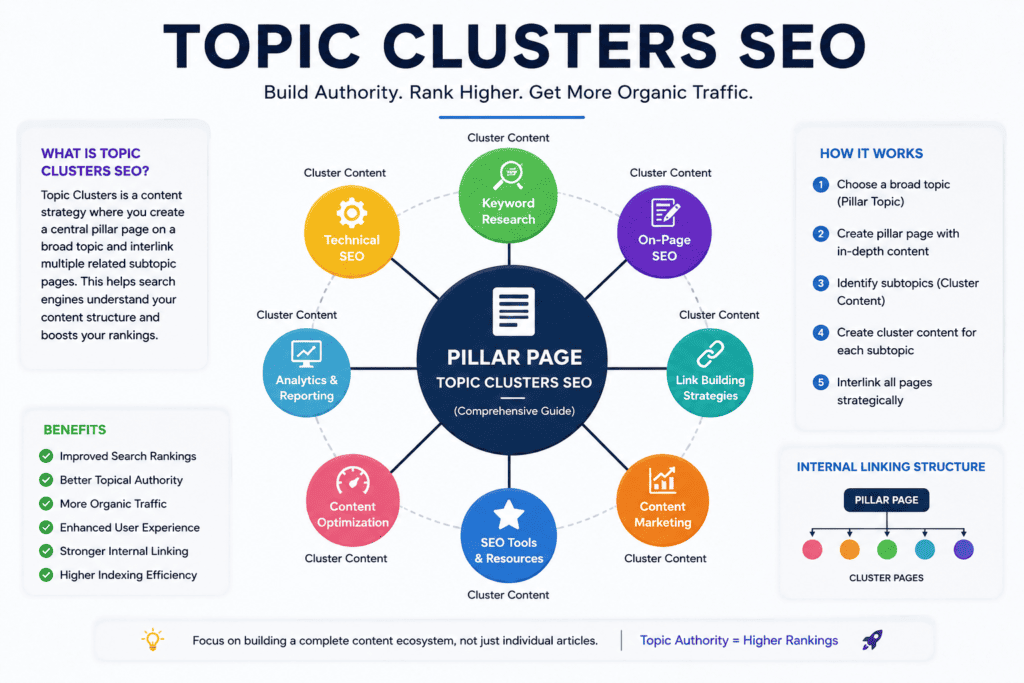
The topic clusters seo strategy is about grouping related content around a page, which we call a pillar page and then adding more detailed pages that link to each other. This helps search engines like Google understand that your website is an expert on a Topic Clusters subject.
Topic Clusters for Search Engine Optimization is a way to do this.
In this guide you will learn:
* What Topic Clusters really mean in 2026 Search Engine Optimization
* How Google interprets Content Mapping today
* How to build a cluster-based Search Engine Optimization architecture
* examples and strategic frameworks
* Common mistakes that kill rankings
* Strategies used by top-performing sites
By the end you will be able to design a complete content system that improves rankings, authority and traffic consistency, for your website using Topic Clusters for Search Engine Optimization.
You will be able to use Topic Clusters for Search Engine Optimization to improve your website.
What Are Topic Clusters in SEO (2026 Perspective)
Topic clusters are not new, but their importance has increased significantly in modern SEO due to Google’s AI-driven ranking systems keyword-research-strategie.
A topic cluster is a structured content model consisting of:
- Pillar Page → Main topic overview page
- Cluster Content → Supporting articles covering subtopics
- Internal Links → Structured linking system connecting everything
Simple Example
If your main topic is:
👉 “Digital Marketing”
Then your cluster system might look like:
- Pillar Page: Digital Marketing Guide
- Cluster Articles:
- SEO basics
- Email marketing strategies
- PPC advertising guide
- Social media marketing trends
- Content marketing strategy
Each article supports the main pillar.
Why Google Loves This Structure
Google in 2026 focuses heavily on:
- Topical authority (not just keywords)
- Semantic relationships between pages
- User journey satisfaction
- Content depth and coverage
When your website uses Topic Clusters SEO, you are essentially telling Google:
“I don’t just know one keyword — I understand the entire topic ecosystem.”
How Google Understands Content Mapping, in 2026
Content mapping is how you put things in order so Google can see how your website is set up.
In 2026 Google uses computer programs that look at Google content mapping. These Google computer programs check things.
- Context between pages
- Internal linking patterns
- Content depth and coverage gaps
- User engagement signals across related pages
What changed from old SEO?
| Old SEO Model | Modern SEO (2026) |
| Single keyword targeting | Topic-based authority |
| Random blog posts | Structured content clusters |
| Backlink-heavy ranking | Relevance + entity understanding |
| Individual page optimization | Site-wide semantic mapping |
This change is why topic clusters and SEO are now important, for every content plan.
Topic clusters and search engine optimization are really important these days.
We need to look at this in a way.
1. Google no longer ranks web pages on their own.
A single article is not enough anymore. Google evaluates:
- Entire website expertise
- Supporting content network
- Internal structure strength
2. Better Crawl Efficiency
Cluster systems help Google bots:
- Discover pages faster
- Understand relationships
- Index content more efficiently
3. Higher Topical Authority
Sites using Topic Clusters SEO appear more authoritative because they:
- Cover topics in depth
- Avoid thin content issues
- Provide structured knowledge
4. Better Website Experience
When users move between topics easily they stay longer and bounce less.
Content Plan (Step-, by-Step Guide)
Lets create a plan you can use.
Step 1: Find Main Website Topics
Begin by picking 3–10 themes of your website.
Example for a marketing site:
- SEO
- Content Marketing
- Social Media Marketing
- Affiliate Marketing
Each becomes a pillar page.
Step 2: Break Down Subtopics
For each pillar, identify subtopics.
Example for SEO:
- On-page SEO
- Technical SEO
- Link building
- Keyword research
- SEO tools
Each subtopic becomes a supporting article.
Step 3: Build Keyword Mapping
Instead of targeting random keywords, map them like this:
| Pillar | Cluster Topic | Keyword Type |
| SEO Guide | On-page SEO | Informational |
| SEO Guide | Technical SEO | Informational |
| SEO Guide | Backlinks strategy | Informational |
This is the heart of Topic Clusters SEO.
Step 4: Create Internal Linking Structure
This is where most websites fail.
Correct structure:
- Cluster articles → link to pillar page
- Pillar page → links to all cluster articles
- Cluster articles → interlink where relevant
Step 5: Build Content Depth
Each cluster article should:
- Solve one specific problem
- Go deeper than competitors
- Include examples and real scenarios
Example of a Complete Topic Cluster
Pillar: SEO Strategy 2026
Cluster Content:
- Keyword Research Methods
- On-page SEO Checklist
- Technical SEO Audit Guide
- Link Building Strategies
- SEO Tools Comparison
This structure forms a topical ecosystem.
What Competitors Miss in Topic Clusters SEO
Most websites fail because they treat clusters as:
“Just internal linking between blogs”
But real Topic Clusters SEO is deeper.
Missing Point 1: No Intent Mapping
Competitors ignore user intent layers:
- Beginner intent
- Comparison intent
- Purchase intent
Missing Point 2: Weak Pillar Pages
They create short pillar pages instead of authoritative guides.
Missing Point 3: No Content Depth Strategy
They publish 100 articles but without:
- Structured hierarchy
- Semantic grouping
- Intent alignment
Missing Point 4: No Content Decay Strategy
Old content is not updated, causing ranking drops.
Expert-Level SEO Insights (2026)
Here are advanced strategies used by top SEO systems:
1. Entity-Based Content Mapping
Google now understands entities (brands, concepts, tools). Instead of focusing only on keywords, align content with entities.
2. Intent Layering Strategy
Each cluster should cover:
- Beginner level content
- Intermediate guides
- Advanced breakdowns
3. Semantic Coverage Expansion
Don’t just target keywords — cover entire topic space.
4. Internal Link Weight Distribution
Pages closer to pillar pages gain stronger SEO signals.
Common Mistakes in Topic Clusters SEO
Avoid these mistakes:
- Creating clusters without pillar pages
- Overlapping topics in multiple clusters
- Weak internal linking structure
- Writing shallow content
- Ignoring search intent variation
- Not updating old content
Beginner vs Advanced Approach
Beginner Approach
- 1 pillar page
- 5 blog posts
- Basic internal linking
Advanced Approach
- Multiple pillar clusters
- Intent-based mapping
- Cross-cluster linking
- Semantic keyword grouping
- Continuous optimization
Advanced strategy leads to long-term dominance.
Practical SEO Strategy Using Topic Clusters
Here’s how to implement immediately:
Step 1: Audit Existing Content
Group existing posts into topics.
Step 2: Identify Missing Clusters
Find gaps in coverage.
Step 3: Build Pillar Pages
Create strong authority pages.
Step 4: Restructure Internal Links
Fix broken or random linking.
Step 5: Expand Cluster Content
Add depth and supporting articles.
Internal Link Suggestions
You can connect this strategy with:
- /seo-content-strategy-2026
- /keyword-research-guide
- /technical-seo-checklist
- /internal-linking-strategy
External Reference Ideas (for credibility)
- Google Search Central documentation
- Ahrefs SEO learning resources
- SEMrush content marketing blog
- Moz SEO guide
Real-World Impact of Topic Clusters SEO
Websites using structured clusters often experience:
- Higher ranking stability
- Increased organic traffic
- Better indexing speed
- Strong topical authority signals
This is because search engines reward structured knowledge systems over scattered content.
Conclusion
In 2026 doing well with Search Engine Optimization is about organizing your information in a good way; it is not just about putting out a lot of stuff.
Search Engine Optimization uses something called Topic Clusters which’s not something you just try, it is a whole system for organizing your Search Engine Optimization content that helps Google understand what your website is about.
If you want your website to always show up near the top of search results, for Search Engine Optimization you need a things:
* Strong main pages that cover topics
* Other pages that are related to these topics and are connected in a way that makes sense
* A plan for what you want people to do when they visit your website
* Links to pages on your website that help people find what they are looking for
When you set up How Topic Clusters SEO Works in 2026, for Search Engine Optimization correctly it makes your website an useful place where people can go to learn things. Your website is not a blog where you post things every now and then. Topic Clusters make your website a place where people can actually learn things about a topic. This is because Topic Clusters help people find what they are looking for on your website.
FAQs
1. What is Topic Clusters SEO?
It is a content strategy where related articles are grouped around a central pillar page to improve SEO structure and authority.
2. Why are topic clusters important in 2026?
Because Google now prioritizes topical authority and semantic relationships between pages.
3. How many cluster articles should a pillar have?
Usually 5–15 supporting articles depending on topic depth.
4. Do topic clusters improve ranking?
Yes, they improve crawlability, authority, and content relevance.
5. What is a pillar page?
A pillar page is like a spot where people can go to learn about a particular thing. The main idea of a pillar page is to have one place where people can go to learn about something so they do not have to search over the place for information about that thing, which is the pillar page.
6. Can small websites use topic clusters?
Yes, even small blogs can benefit by organizing content properly.
7. What is content mapping in SEO?
It is the process of structuring content logically into topics and subtopics.
8. Is internal linking important in clusters?
Yes, it is the backbone of topic cluster SEO.
9. How long does it take to see the results of the content?
It can take months like 2 to 4 months to see the results of the content. This is because it depends on the competition and the quality of the content.
10. What is the biggest mistake in topic clusters?
Publishing disconnected articles without a structured pillar system.