

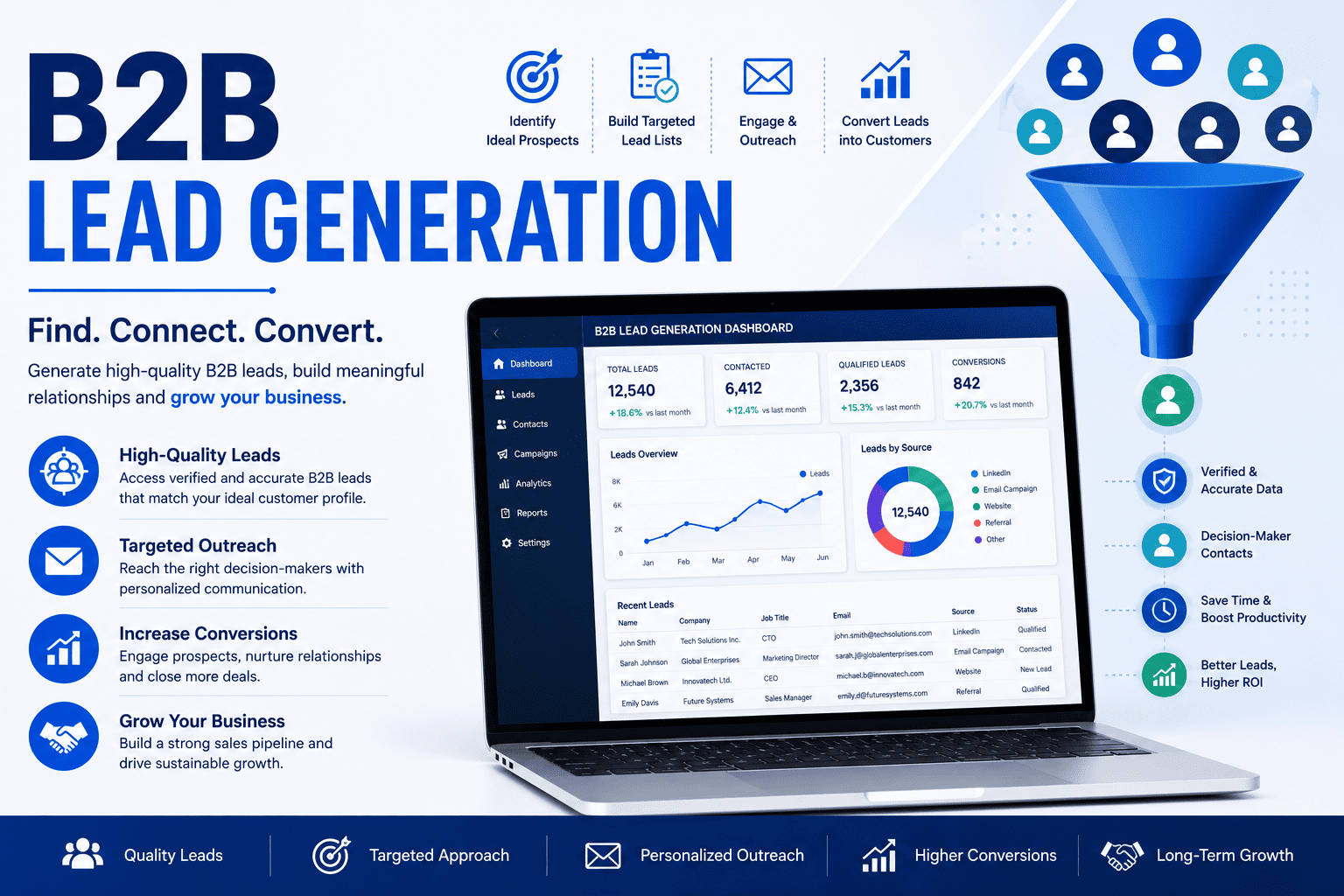
In today’s competitive digital marketplace, generating a steady flow of qualified business leads is no longer optional it’s essential. Whether you run a startup, a growing agency, or an established enterprise, your ability to consistently connect with potential customers directly influences your revenue and long-term success.
Unlike B2C marketing, where purchasing decisions are often emotional and immediate, B2B buying journeys involve multiple decision-makers, extensive research, and longer sales cycles. As a result, businesses need a strategic and data-driven approach to attract prospects who genuinely need their products or services.
This is where B2B lead generation becomes one of the most valuable growth strategies. Rather than relying on cold outreach alone, modern organizations combine content marketing, search engine optimization (SEO), social selling, email campaigns, and marketing automation to build predictable sales pipelines.
In this comprehensive guide, you’ll learn what B2B lead generation is, why it matters, how the process works, and the foundational strategies every business owner should implement to generate qualified leads consistently.
What Is B2B Lead Generation?
B2B lead generation is the process of attracting, identifying, and converting businesses or professionals who have shown interest in your products or services into potential customers.
Instead of selling directly to individual consumers, B2B companies focus on reaching organizations, decision-makers, executives, procurement teams, and business owners who have the authority to purchase business solutions.
A lead may come from various sources, including:
- Organic search
- Company website
- Email campaigns
- Webinars
- Industry events
- Paid advertising
- Referral programs
- Content downloads
The ultimate objective is to move interested prospects through the sales funnel until they become paying customers.
Featured Snippet: What Is B2B Lead Generation?
B2B lead generation is the process of attracting and converting businesses into potential customers through marketing and sales strategies such as SEO, content marketing, email outreach, social selling, paid advertising, and referrals. Its goal is to create a pipeline of qualified prospects that can be nurtured into long-term clients.
Why Is B2B Lead Generation Important?
Many businesses invest heavily in developing exceptional products and services but struggle because they lack a consistent system for acquiring new customers.
Effective lead generation solves this problem by creating a predictable flow of qualified opportunities.
Some of the biggest benefits include:
- Builds a reliable sales pipeline
- Increases revenue opportunities
- Improves brand visibility
- Reduces customer acquisition costs over time
- Generates higher-quality prospects
- Supports sustainable business growth
- Enhances marketing ROI
- Creates long-term customer relationships
Businesses that consistently generate qualified leads spend less time chasing unqualified prospects and more time closing valuable deals.
How the B2B Lead Generation Process Works
Successful lead generation isn’t a single activity—it’s a structured process that guides prospects from awareness to purchase.
Step 1: Identify Your Ideal Customer
Everything begins with understanding who you’re trying to reach.
Consider factors such as:
- Industry
- Company size
- Annual revenue
- Geographic location
- Job titles
- Business challenges
- Purchasing authority
- Technology stack
The clearer your ideal customer profile (ICP), the more effective your marketing efforts become.
Step 2: Attract Qualified Visitors
Once you’ve defined your audience, the next step is bringing relevant traffic to your business.
Popular traffic sources include:
- SEO
- Blog content
- LinkedIn marketing
- Google Ads
- Social media
- YouTube
- Industry publications
- Podcasts
- Guest posting
The goal isn’t simply to generate traffic—it’s to attract the right audience.
Step 3: Capture Lead Information
Visitors become leads only when they voluntarily share their information.
Businesses commonly collect:
- Name
- Business email
- Company name
- Job title
- Phone number
- Company size
This usually happens through:
- Contact forms
- Newsletter subscriptions
- Free guides
- Whitepapers
- Webinar registrations
- Free consultations
- Product demos
Offering valuable resources in exchange for contact information significantly increases conversion rates.
Step 4: Qualify Leads
Not every lead is ready to buy.
Businesses typically evaluate leads based on:
- Budget
- Authority
- Need
- Timeline
Sales teams often prioritize leads who closely match their ideal customer profile and demonstrate genuine purchase intent.
Step 5: Nurture Relationships
Many B2B buyers require weeks—or even months—before making a purchasing decision.
Lead nurturing helps maintain engagement through:
- Educational emails
- Case studies
- Product updates
- Industry insights
- Personalized recommendations
- Success stories
Trust is built over time, making nurturing an essential part of the buying journey.
Types of B2B Leads
Understanding lead quality helps businesses allocate resources more effectively.
| Lead Type | Description | Sales Readiness |
| Marketing Qualified Lead (MQL) | Has interacted with marketing content but isn’t ready to purchase | Medium |
| Sales Qualified Lead (SQL) | Evaluated by the sales team and considered purchase-ready | High |
| Product Qualified Lead (PQL) | Experienced the product through a free trial or demo | Very High |
| Warm Lead | Already familiar with your business and interested | High |
| Cold Lead | Limited or no prior interaction with your brand | Low |
The objective is to move leads from awareness toward purchase through personalized communication and valuable content.
Core Channels for B2B Lead Generation
Successful companies rarely depend on a single marketing channel. Instead, they build a diversified lead generation strategy.
1. Search Engine Optimization (SEO)
SEO remains one of the highest-return investments because it attracts prospects actively searching for solutions.
Benefits include:
- Long-term traffic
- Higher trust
- Lower acquisition costs
- Consistent inbound leads
- Improved brand authority
Creating helpful, in-depth content around customer questions allows businesses to rank for valuable search terms while demonstrating expertise.
2. Content Marketing
High-quality content establishes credibility before a sales conversation even begins.
Popular content formats include:
- Blog articles
- Industry guides
- Whitepapers
- eBooks
- Case studies
- Templates
- Videos
- Checklists
Educational content positions your business as a trusted resource rather than simply another vendor.
3. LinkedIn Marketing
LinkedIn has become one of the most powerful platforms for B2B networking and lead generation.
Businesses use LinkedIn to:
- Connect with decision-makers
- Publish thought leadership
- Share industry insights
- Promote webinars
- Build authority
- Generate inbound inquiries
Consistent engagement often produces stronger relationships than direct sales pitches.
4. Email Marketing
Email remains one of the most effective methods for nurturing leads throughout the buying journey.
A successful B2B email strategy focuses on providing value rather than constantly promoting products.
Effective campaigns include:
- Educational newsletters
- Product updates
- Personalized recommendations
- Event invitations
- Industry reports
- Customer success stories
Well-segmented email campaigns often achieve higher engagement because they address the specific needs of different audience groups.
Key Takeaways
Building a successful B2B lead generation strategy starts with understanding your ideal customer and creating a structured process to attract, capture, qualify, and nurture leads. Rather than relying on one channel, businesses should combine SEO, valuable content, LinkedIn engagement, and email marketing to establish trust and generate a steady pipeline of qualified prospects. These foundational practices lay the groundwork for scalable, sustainable business growth.
Advanced B2B Lead Generation Strategies That Drive Results
Once you’ve established the fundamentals of B2B lead generation, the next step is optimizing your efforts with strategies that attract higher-quality prospects and improve conversion rates. Modern buyers expect personalized experiences, valuable content, and meaningful interactions before they commit to a purchase. Businesses that meet these expectations are far more likely to build trust and win long-term clients.
Below are some of the most effective strategies for generating qualified B2B leads in today’s competitive market.
1. Create High-Value Lead Magnets
A lead magnet is a valuable resource offered in exchange for a prospect’s contact information. Instead of asking visitors to “Contact Us” immediately, provide something genuinely useful that solves a problem or answers an important question.
Effective lead magnets include:
- Comprehensive industry guides
- eBooks
- Whitepapers
- Checklists
- Templates
- ROI calculators
- Market research reports
- Free audits
- Product demos
- Webinar registrations
The key is relevance. Your lead magnet should address a challenge your ideal customer is actively trying to solve.
Example
A cybersecurity company might offer a free Cybersecurity Risk Assessment Checklist, while a digital marketing agency could provide an SEO Audit Template. These resources attract prospects already interested in the services being offered.
2. Invest in Account-Based Marketing (ABM)
Not every prospect deserves the same level of attention. Account-Based Marketing (ABM) focuses on identifying high-value target companies and creating personalized campaigns specifically for them.
Rather than marketing to thousands of businesses, ABM concentrates resources on organizations that closely match your Ideal Customer Profile (ICP).
Benefits of ABM
- Higher conversion rates
- Better alignment between marketing and sales
- Improved customer relationships
- Increased deal sizes
- More efficient use of marketing budgets
Example Workflow
- Identify high-value companies.
- Research decision-makers.
- Create personalized messaging.
- Share relevant case studies and insights.
- Schedule consultations or product demonstrations.
- Continue nurturing until the buying decision is made.
Personalization often makes the difference between being ignored and starting a meaningful business conversation.
3. Leverage LinkedIn for Social Selling
LinkedIn has evolved far beyond a professional networking platform. It is now one of the most powerful channels for B2B lead generation because it allows businesses to connect directly with executives, managers, founders, and decision-makers.
Instead of sending generic sales messages, focus on building relationships.
Best Practices
- Optimize your company and personal profiles.
- Publish educational posts regularly.
- Comment thoughtfully on industry discussions.
- Share customer success stories.
- Participate in relevant professional groups.
- Send personalized connection requests.
- Follow up with value rather than a sales pitch.
Consistent engagement builds familiarity, and familiarity often leads to trust.
4. Build Authority Through Educational Content
Businesses rarely buy from companies they don’t trust. Publishing helpful, well-researched content demonstrates expertise and positions your brand as a reliable industry resource.
Consider creating:
- Long-form blog posts
- Industry reports
- Case studies
- Video tutorials
- Podcasts
- Expert interviews
- Comparison guides
- Frequently Asked Questions
Instead of focusing solely on promoting your products, answer the questions your audience is already asking. Educational content attracts organic traffic while supporting every stage of the buyer’s journey.
5. Optimize Landing Pages for Conversions
Driving traffic is only half the equation. If your landing pages fail to convert visitors into leads, even the best marketing campaigns will underperform.
A high-converting landing page should include:
- A compelling headline
- A clear value proposition
- Concise, benefit-focused copy
- Customer testimonials or social proof
- A strong call to action
- Minimal distractions
- A simple lead capture form
Example Comparison
| Weak Landing Page | High-Converting Landing Page |
| Generic headline | Clear value-driven headline |
| Long forms | Short, easy-to-complete forms |
| No testimonials | Customer reviews and case studies |
| Multiple CTAs | One focused CTA |
| Cluttered layout | Clean, mobile-friendly design |
Small improvements in landing page design can significantly increase lead conversion rates.
6. Use Marketing Automation to Scale
As your business grows, manually managing every lead becomes impractical. Marketing automation helps businesses nurture prospects efficiently while maintaining a personalized experience.
Automation can handle tasks such as:
- Welcome email sequences
- Lead scoring
- Follow-up reminders
- Webinar invitations
- Personalized recommendations
- Re-engagement campaigns
Automation saves time, reduces manual work, and ensures that no qualified lead is overlooked.
7. Measure the Right Performance Metrics
Without measurement, it’s impossible to know whether your lead generation strategy is working.
Monitor key performance indicators (KPIs) such as:
- Website traffic
- Organic search growth
- Landing page conversion rate
- Cost per lead (CPL)
- Customer acquisition cost (CAC)
- Email open and click-through rates
- Qualified leads generated
- Sales conversion rate
- Return on marketing investment (ROMI)
Regularly reviewing these metrics helps identify opportunities for improvement and ensures your marketing budget is being used effectively.
Real-World Example: How Content Marketing Generates Qualified Leads
Imagine a software company that provides project management solutions for medium-sized businesses.
Instead of relying exclusively on paid advertising, the company develops a content strategy that includes:
- Weekly blog articles addressing common project management challenges
- Downloadable productivity templates
- Monthly webinars featuring industry experts
- Customer case studies highlighting measurable results
- SEO-optimized comparison guides
Visitors searching for solutions discover the content through search engines, download valuable resources, subscribe to the newsletter, and eventually request a product demonstration.
By educating prospects before attempting to sell, the company builds credibility and attracts leads who are already informed about their challenges and potential solutions.
Common Challenges in B2B Lead Generation
Even well-planned campaigns encounter obstacles. Recognizing these challenges allows businesses to adapt more effectively.
Low-Quality Leads
Generating a large number of leads means little if they don’t match your target audience.
Solution: Refine your Ideal Customer Profile, improve targeting, and use lead scoring to prioritize high-potential prospects.
Long Sales Cycles
B2B purchasing decisions often involve multiple stakeholders and lengthy evaluation processes.
Solution: Stay engaged through consistent lead nurturing, educational content, and personalized communication.
Poor Sales and Marketing Alignment
When marketing and sales teams operate independently, qualified opportunities may be overlooked.
Solution: Establish shared goals, define lead qualification criteria together, and maintain regular communication between teams.
Limited Brand Awareness
Businesses with low visibility often struggle to attract inbound leads.
Solution: Invest in SEO, thought leadership, guest publishing, webinars, and social media engagement to increase credibility and reach.
Actionable Tips to Improve Your B2B Lead Generation Strategy
If you’re looking for practical ways to strengthen your lead generation efforts, start with these proven tactics:
- Clearly define your Ideal Customer Profile before launching campaigns.
- Focus on solving customer problems instead of promoting features.
- Publish high-quality content consistently.
- Optimize every landing page for conversions.
- Use personalized email sequences rather than generic messages.
- Leverage LinkedIn to build genuine professional relationships.
- Track performance metrics and refine campaigns regularly.
- Test different headlines, calls to action, and lead magnets through A/B testing.
- Follow up promptly with new leads to maintain momentum.
- Continuously update your content to reflect industry trends and customer needs.
Businesses that treat lead generation as an ongoing process—not a one-time campaign—are better positioned to achieve sustainable growth.
Common B2B Lead Generation Mistakes to Avoid
Even experienced marketers can make mistakes that reduce the effectiveness of their lead generation efforts. Recognizing these pitfalls can help your business build a more efficient and profitable sales pipeline.
1. Targeting the Wrong Audience
One of the biggest mistakes is trying to market to everyone. Without a clearly defined Ideal Customer Profile (ICP), your campaigns may generate leads that are unlikely to convert.
Best Practice: Focus on industries, company sizes, job roles, and business challenges that align with your solution.
2. Prioritizing Quantity Over Quality
A large database of contacts may look impressive, but if those leads aren’t qualified, your sales team will waste valuable time.
Best Practice: Implement lead scoring and qualification criteria to identify prospects with genuine buying intent.
3. Ignoring Lead Nurturing
Many businesses expect prospects to make immediate purchasing decisions. In reality, B2B buyers often need multiple interactions before they are ready to buy.
Best Practice: Use email sequences, educational content, webinars, and case studies to stay engaged throughout the buyer’s journey.
4. Weak Calls to Action
If your content doesn’t clearly guide visitors toward the next step, you’ll lose potential opportunities.
Examples of effective CTAs include:
- Schedule a Free Consultation
- Download the Complete Guide
- Request a Product Demo
- Get Your Free Audit
- Speak with an Expert
Every page should encourage visitors to take one clear action.
5. Failing to Measure Results
Without tracking performance, it’s impossible to know which strategies are delivering the best return on investment.
Regularly review metrics such as:
- Lead conversion rate
- Cost per lead
- Customer acquisition cost
- Email engagement
- Website traffic
- Sales-qualified leads
- Revenue generated from marketing campaigns
Data-driven decisions consistently outperform assumptions.
Future Trends in B2B Lead Generation
The B2B landscape continues to evolve as buyer expectations and technology change. Businesses that adapt early will be better positioned to attract and convert qualified prospects.
AI-Powered Personalization
Artificial intelligence is enabling businesses to deliver more personalized experiences by analyzing customer behavior and recommending relevant content, products, or services.
However, AI should complement—not replace—human expertise and relationship building.
First-Party Data Strategies
As privacy regulations evolve and third-party cookies become less reliable, businesses are placing greater emphasis on collecting first-party data through newsletters, webinars, downloadable resources, and customer interactions.
Building trust encourages prospects to willingly share their information.
Video Content
Decision-makers increasingly consume video content to learn about products, services, and industry trends.
Consider incorporating:
- Product demonstrations
- Customer testimonials
- Educational webinars
- Expert interviews
- Behind-the-scenes content
Video helps simplify complex topics while building credibility.
Interactive Content
Interactive experiences often generate higher engagement than static content.
Examples include:
- ROI calculators
- Self-assessment tools
- Industry quizzes
- Interactive product tours
- Pricing calculators
These resources provide immediate value while encouraging visitors to share their contact information.
Sales and Marketing Alignment
Organizations are increasingly recognizing the importance of collaboration between marketing and sales teams.
When both departments share goals, qualification criteria, and customer insights, businesses typically experience:
- Faster response times
- Better customer experiences
- Higher conversion rates
- Improved revenue growth
Alignment is no longer optional—it’s a competitive advantage.
Frequently Asked Questions (FAQs)
1. What is B2B lead generation?
B2B lead generation is the process of attracting and converting businesses or professional decision-makers into potential customers using strategies such as SEO, content marketing, email campaigns, social selling, referrals, and paid advertising.
2. What is the difference between B2B and B2C lead generation?
B2B lead generation targets businesses and organizational decision-makers, while B2C lead generation focuses on individual consumers. B2B sales cycles are generally longer and involve multiple stakeholders, making relationship-building and education especially important.
3. Which channel is most effective for B2B lead generation?
There isn’t a single best channel for every business. A combination of SEO, valuable content, LinkedIn networking, email marketing, referrals, and strategic paid advertising often delivers the strongest long-term results.
4. How can small businesses generate B2B leads with a limited budget?
Small businesses can achieve meaningful results by:
- Publishing helpful blog content
- Optimizing their website for search engines
- Building a strong LinkedIn presence
- Sending targeted email campaigns
- Encouraging customer referrals
- Guest posting on reputable industry websites
These approaches require more consistency than large advertising budgets.
5. How long does B2B lead generation take?
The timeline depends on the strategy being used. Paid advertising may generate leads quickly, while SEO and content marketing typically require several months to build momentum. Businesses that combine both short-term and long-term strategies often see the best overall performance.
6. What makes a high-quality B2B lead?
A high-quality lead closely matches your Ideal Customer Profile, has a genuine business need, possesses purchasing authority or influence, and demonstrates clear interest in your solution through meaningful engagement.
7. How do you measure the success of a B2B lead generation campaign?
Success is measured by tracking key metrics such as qualified leads generated, conversion rates, customer acquisition cost, sales pipeline growth, return on marketing investment, and overall revenue influenced by lead generation activities.
Conclusion
Effective B2B lead generation is about more than filling a sales pipeline—it’s about creating meaningful relationships with businesses that genuinely benefit from your products or services. Companies that consistently attract, qualify, and nurture the right prospects are better equipped to achieve sustainable growth and build long-term customer loyalty.
Success begins with understanding your ideal audience, delivering valuable content that addresses their challenges, and maintaining consistent engagement throughout the buying journey. Rather than relying on a single tactic, the most resilient businesses combine search engine optimization, educational content, social selling, email marketing, marketing automation, and data-driven decision-making to create a scalable lead generation system.
It’s equally important to evaluate performance regularly. Tracking key metrics, refining your messaging, and responding to changing market conditions will help ensure your strategy remains effective over time. As technology and buyer expectations continue to evolve, businesses that prioritize trust, expertise, and customer value will remain ahead of the competition.
Whether you’re launching your first lead generation campaign or optimizing an existing strategy, focusing on quality over quantity and building genuine relationships will produce stronger results than short-term tactics. By implementing the strategies outlined in this guide, business owners can create a reliable pipeline of qualified leads, improve conversion rates, and position their organizations for long-term success.
Key Takeaways
- Define a detailed Ideal Customer Profile before launching campaigns.
- Prioritize lead quality over the total number of leads.
- Use SEO and educational content to generate sustainable inbound traffic.
- Build trust through thought leadership and valuable resources.
- Leverage LinkedIn and email marketing to nurture business relationships.
- Optimize landing pages with clear value propositions and strong calls to action.
- Use marketing automation to scale lead nurturing efficiently.
- Measure KPIs regularly and refine your strategy based on data.
- Stay informed about emerging trends such as AI-driven personalization and first-party data strategies.
- Focus on delivering consistent value to create lasting customer relationships and drive sustainable business growth.