

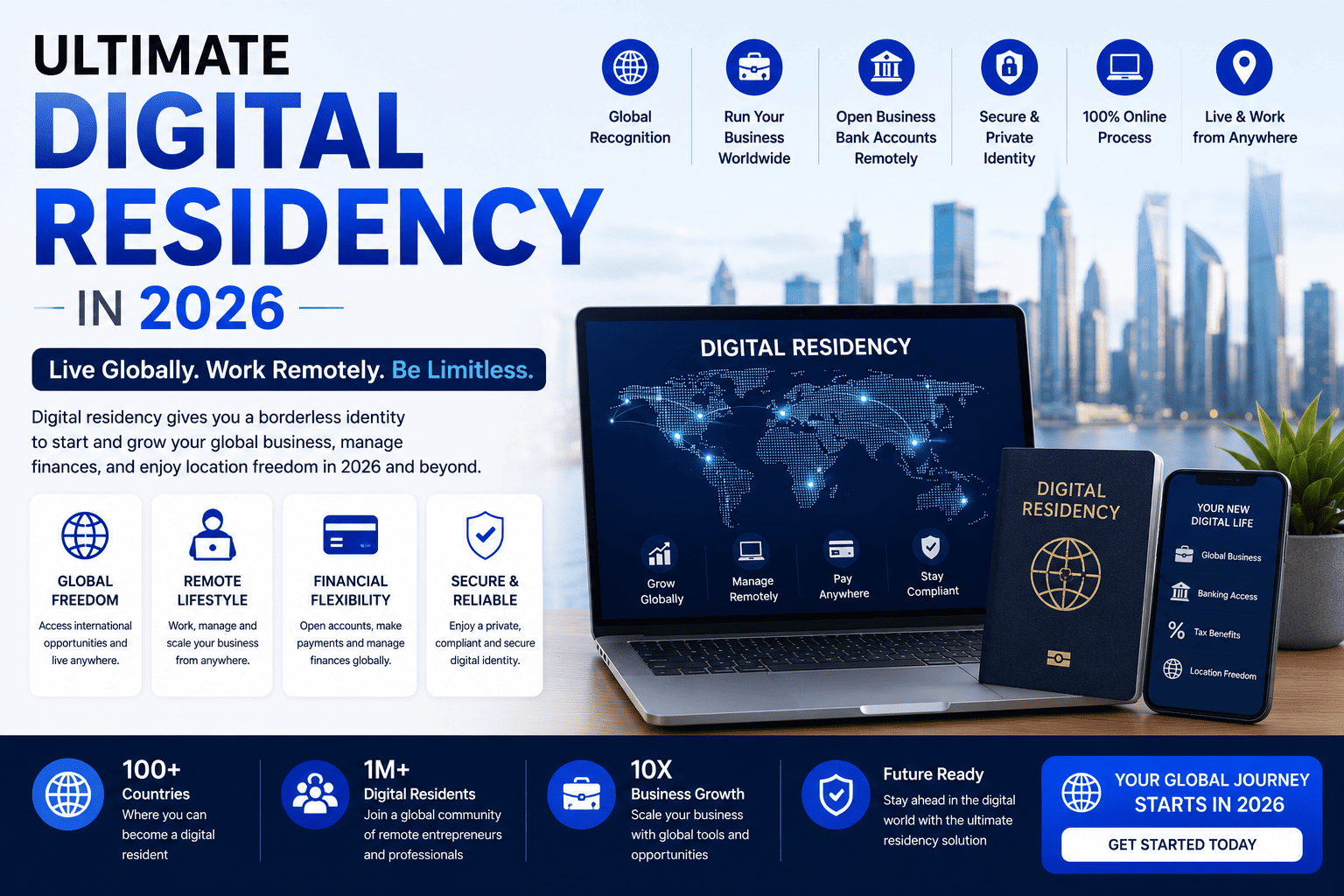
More than 120,000 people have already applied for Estonia’s pioneering digital residency program—and the number continues to rise as entrepreneurs, freelancers, and business owners embrace borderless business.
At first glance, many assume digital residency is about relocating or gaining the right to live abroad. In reality, it’s something entirely different. Digital residency is a secure digital identity that allows individuals to establish and manage a business online, regardless of where they physically live. It removes geographical barriers from administrative processes, making entrepreneurship more accessible in an increasingly connected world.
As one software developer aptly remarked in an online discussion, “The system doesn’t care where you sit—only who you are.” That simple observation captures the essence of digital residency. It is built on verified identity rather than physical location, enabling people to sign documents securely, manage companies remotely, and access digital government services from virtually anywhere.
However, the concept becomes far more complex once taxation, banking, legal compliance, and international business structures come into play. While digital residency opens remarkable opportunities for global entrepreneurs, it also introduces responsibilities and regulatory considerations that many newcomers fail to anticipate until they are actively operating a business.
In this guide, we’ll explore what digital residency really means in 2026, how it works, why its popularity continues to grow, and the practical realities that every entrepreneur should understand before deciding whether it’s the right solution for their business.
What Is Digital Residency? A Complete Guide to the Borderless Business Revolution in 2026
Digital residency is one of the most significant innovations reshaping global entrepreneurship. Rather than being a form of immigration, citizenship, or permanent residence, it is a government-issued digital identity that allows verified individuals to securely access selected public and business services online from anywhere in the world.
In practical terms, digital residency enables entrepreneurs to establish and manage companies remotely, authenticate their identity through secure digital credentials, sign legally binding documents with encrypted digital signatures, and complete essential administrative processes without being physically present in the issuing country. It transforms complex cross-border business operations into streamlined digital workflows while maintaining high standards of security and legal compliance.
The most successful and widely recognized example is Estonia’s e-Residency program, introduced in 2014. Since its launch, the initiative has attracted more than 120,000 applicants from over 170 countries, demonstrating that digital residency has evolved from an ambitious government project into a globally trusted digital business ecosystem. Today, it serves entrepreneurs, startup founders, consultants, freelancers, investors, and remote-first companies seeking efficient access to international markets.
What makes digital residency truly revolutionary is its ability to separate business identity from physical location. Traditionally, launching or operating an international company required frequent travel, extensive paperwork, local representation, and time-consuming bureaucratic procedures. Digital residency replaces many of these obstacles with secure digital verification, allowing business owners to complete critical corporate tasks online with confidence and legal recognition.
For today’s global professionals, this creates entirely new opportunities. A software developer in Asia can establish a European company to serve international clients. A digital marketing consultant in Africa can manage contracts, invoices, and compliance through a trusted legal entity. A startup founder in South America can build a globally competitive business without relocating employees or opening physical offices abroad.
However, digital residency is not a shortcut to immigration, tax avoidance, or unrestricted access to another country’s economy. It does not provide citizenship, permanent residence, work authorization, or automatic tax benefits. Instead, it offers a secure digital framework that simplifies business administration while requiring entrepreneurs to comply with applicable tax regulations, corporate governance rules, and international legal obligations.
As the global economy becomes increasingly digital, the importance of trusted online identity continues to grow. Businesses are no longer defined by where their founders live but by how efficiently they can operate across borders. In 2026, digital residency represents far more than technological convenience—it has become a strategic tool that empowers entrepreneurs to build internationally recognized businesses with greater flexibility, operational efficiency, and global credibility than ever before.
Digital Residency Demystified
One of the biggest misconceptions surrounding digital residency is created by the word “residency” itself. For many people, it immediately brings to mind citizenship, immigration, visas, or the legal right to live in another country. In reality, digital residency has an entirely different purpose.
Digital residency is designed to create a trusted digital identity, not a physical presence. It enables individuals to interact securely with selected government and business services online while remaining in their home country. It simplifies international business administration, but it does not change your immigration status or replace existing legal requirements.
Understanding this distinction is essential before applying, as it prevents unrealistic expectations and helps entrepreneurs make informed business decisions.
| What Digital Residency Gives You | What Digital Residency Does Not Give You |
| A government-issued, verified digital identity | Citizenship or a national passport |
| The ability to establish and manage a business remotely | A visa, residence permit, or travel authorization |
| Legally recognized digital signatures for official documents | Automatic tax residency or tax exemptions |
| Secure online access to selected government and business services | The legal right to live, work, or settle in the issuing country |
| A trusted framework for conducting cross-border business operations | An exemption from local or international compliance obligations |
| Greater efficiency for entrepreneurs operating internationally | A shortcut around banking, legal, accounting, or regulatory requirements |
The key principle is straightforward: digital residency grants digital access—not physical rights. It verifies your identity in a secure online environment, allowing you to establish and operate a business more efficiently across borders. However, it does not alter your nationality, immigration status, tax obligations, or legal responsibilities.
For entrepreneurs, freelancers, consultants, and globally focused businesses, this distinction is more than a technical detail—it is the foundation of responsible international business. Digital residency should be viewed as a powerful tool for digital governance and cross-border entrepreneurship, not as an alternative to immigration or a means of avoiding legal compliance.
Understanding where digital residency begins—and where its legal limits end—is one of the most important steps toward using it effectively in today’s interconnected business landscape.
Why Digital Residency Is Becoming Essential for Global Entrepreneurs in 2026
The growing interest in digital residency is not simply the result of technological innovation—it reflects a fundamental transformation in the way people work, build businesses, and collaborate across borders.
According to the International Labour Organization (ILO), the global labor market continues to evolve as digital employment, remote collaboration, and cross-border work become increasingly common. While global unemployment remained around 5% in 2024, the rapid expansion of remote work, freelancing, digital entrepreneurship, and distributed teams has fundamentally changed how businesses operate. This shift has created new opportunities—but it has also introduced new legal, administrative, and compliance challenges for professionals working internationally.
As businesses become increasingly location-independent, traditional administrative systems are struggling to keep pace. Professionals who earn income across multiple countries often discover that managing a business is far more complex than delivering the work itself.
Questions that once affected only multinational corporations are now becoming everyday concerns for independent professionals and growing startups:
- Where should my business be legally registered?
- How can I invoice international clients professionally?
- Which jurisdiction offers the most efficient business environment?
- How do I maintain compliance while operating across multiple countries?
- How can I establish greater credibility with global clients and partners?
These are precisely the challenges that have brought digital residency into the spotlight.
Rather than changing where a person lives, digital residency simplifies how a business operates. It provides entrepreneurs with a secure digital identity that supports company administration, document authentication, and access to selected online government services, allowing many essential business activities to be completed remotely.
Consider a software consultant in Africa serving clients across North America and Europe, or a creative agency owner in Southeast Asia managing projects for companies worldwide. Although their businesses operate digitally, they still require legally recognized contracts, structured invoicing, secure document signing, and efficient company administration. Without a reliable legal framework, these essential processes quickly become complex and time-consuming.
This growing demand for efficiency is exactly why digital residency is attracting increasing attention worldwide. It bridges the gap between modern digital business and traditional legal systems, enabling entrepreneurs to operate internationally with greater flexibility, credibility, and operational confidence.
However, digital residency is not a shortcut around legal responsibilities. Businesses must still comply with applicable tax laws, financial regulations, corporate governance requirements, and jurisdiction-specific compliance rules. Digital residency streamlines administration—it does not replace legal obligations.
In today’s borderless economy, competitive businesses need more than the freedom to work remotely. They need trusted digital infrastructure, internationally recognized business processes, and secure online governance. That is why digital residency is rapidly becoming one of the most valuable tools for entrepreneurs building globally connected businesses in 2026.
The Tax Reality of Digital Residency:
One of the most common—and costly—misconceptions about digital residency is the belief that it automatically simplifies taxation. In reality, digital residency and tax residency are two entirely separate legal concepts. Obtaining a digital identity or establishing a company through a digital residency program does not change where you owe taxes or eliminate your reporting obligations.
Tax responsibilities are determined by factors such as your country of residence, citizenship, where your business is managed, the source of your income, and the tax laws that apply to your specific circumstances. Digital residency can streamline business administration, but it does not replace domestic or international tax regulations.
For many entrepreneurs, this distinction becomes especially important when operating across multiple jurisdictions. A business may be incorporated in one country, managed from another, and serve clients around the world. While this creates tremendous opportunities for global growth, it also introduces additional layers of tax planning, reporting, and regulatory compliance.
For U.S. citizens and permanent residents, the situation is even more complex. The United States taxes its citizens based on citizenship rather than residence, meaning Americans generally remain responsible for filing annual U.S. tax returns even while living and working abroad. Depending on their circumstances, they may also need to report foreign bank accounts, overseas assets, and foreign business interests under applicable U.S. reporting requirements.
This is why many internationally operating entrepreneurs rely on U.S. expat tax software solutions or experienced cross-border tax professionals. These tools help manage tax filings, foreign income reporting, available exclusions and credits, and ongoing compliance with evolving international tax regulations.
The same principle applies beyond the United States. Entrepreneurs operating internationally should carefully evaluate:
- Their personal tax residency status.
- The tax obligations of their business entity.
- Corporate tax rules in the country of incorporation.
- Double taxation agreements between countries.
- Ongoing reporting and compliance requirements.
Digital residency offers flexibility, efficiency, and easier access to international business infrastructure—but it does not remove legal responsibilities. Instead, it provides a modern framework for operating globally while requiring business owners to remain compliant with the tax laws of every jurisdiction that applies to them.
The most successful global entrepreneurs understand this distinction early. They treat digital residency as a powerful business tool—not as a tax strategy. When combined with proper financial planning, professional tax advice, and full regulatory compliance, digital residency becomes a valuable foundation for sustainable international growth rather than a source of unexpected legal complications.
Building Trust in an Increasingly Digital World
The value of digital residency extends far beyond company formation and international entrepreneurship. At its core, it represents a new model of digital trust—one that is becoming essential as governments, businesses, and individuals conduct more of their interactions online.
In today’s interconnected economy, identity has become one of the most valuable digital assets. Whether signing a legally binding contract, opening a business account, verifying ownership of a company, or accessing government services, every digital interaction depends on one fundamental question: Can your identity be trusted?
Digital residency addresses this challenge by providing a secure, government-issued digital identity that enables verified individuals to authenticate themselves with confidence. Rather than relying on repeated manual verification processes, users can securely access approved services through encrypted digital credentials and legally recognized digital signatures. This not only improves efficiency but also strengthens security, transparency, and confidence in cross-border transactions.
Its significance reaches well beyond entrepreneurs. Digital residency supports a growing ecosystem of professionals who operate internationally, including freelancers, consultants, investors, remote employees, startup founders, and digital-first organizations. As work becomes increasingly location-independent, trusted digital identity is evolving into a fundamental requirement for participating in the global digital economy.
The broader impact is even more profound. Modern economies are gradually shifting from systems built around physical presence to systems built around verified digital identity. Governments are digitizing public services, financial institutions are expanding remote verification, and businesses are embracing paperless operations. In this environment, trust is no longer established through face-to-face interactions alone—it is created through secure digital infrastructure and reliable identity verification.
However, this transformation also raises important questions. As more aspects of professional and financial life move online, individuals become increasingly dependent on digital identity systems to access essential services. While these technologies offer remarkable convenience and efficiency, they also highlight the growing importance of cybersecurity, privacy protection, and responsible data governance.
This is why digital residency matters far beyond business administration. It represents a significant step toward a future where trusted digital identity becomes the foundation of global commerce, online collaboration, and secure public services. In 2026, digital residency is no longer simply a tool for entrepreneurs—it is an integral part of the broader digital transformation that is reshaping how people establish trust, conduct business, and participate in the global economy.
As digital interactions continue to replace traditional paper-based processes, one principle becomes increasingly clear: the future of global connectivity will depend not only on where people live, but on how securely and reliably they can prove who they are in the digital world.
The Digital Government Revolution
Digital residency is part of a much larger transformation that extends far beyond business. Around the world, governments are reimagining how public services are delivered, replacing traditional paper-based administration with secure digital infrastructure designed to make interactions faster, safer, and more accessible.
Among the global leaders in this movement, Estonia has established itself as the benchmark for digital governance. Through decades of investment in digital infrastructure, the country has built one of the world’s most advanced e-government ecosystems. Today, nearly all public services can be accessed online, allowing citizens, residents, and e-residents to complete essential administrative tasks without lengthy paperwork or unnecessary visits to government offices.
From company registration and digital signatures to tax reporting and official document management, Estonia has demonstrated how secure digital identity can transform the relationship between governments, businesses, and individuals. Instead of navigating complex bureaucratic procedures, users interact with streamlined digital platforms that prioritize efficiency, transparency, and strong cybersecurity.
The success of this model has inspired governments across Europe, Asia, the Middle East, and other regions to accelerate their own digital transformation initiatives. While the pace of adoption varies from country to country, the direction is increasingly clear. Governments recognize that modern economies require digital-first public services capable of supporting entrepreneurs, attracting international investment, and meeting the expectations of an increasingly connected population.
Not every digital government platform delivers the same experience. Some countries have developed highly integrated systems where administrative processes are completed within minutes through secure online portals. Others are still modernizing legacy infrastructure, resulting in fragmented services and inconsistent user experiences. These differences highlight an important reality: digital transformation is not simply about digitizing paperwork—it requires comprehensive investment in technology, cybersecurity, legal frameworks, and user-centered design.
As global commerce becomes increasingly digital, governments that embrace secure digital identity and efficient online public services will be better positioned to support innovation, strengthen economic competitiveness, and improve public trust. Digital residency is one of the clearest examples of this evolution, demonstrating how governments can extend trusted digital services beyond physical borders while maintaining security and regulatory integrity.
The future of public administration is no longer defined by physical offices, paper files, or long waiting times. It is being shaped by secure digital ecosystems that allow people and businesses to interact with governments quickly, transparently, and from virtually anywhere in the world. In 2026, digital residency is not simply a technological innovation—it is a powerful symbol of how modern governance is evolving to meet the demands of a truly digital global economy.
Shaping the Next Generation of Global Business
Digital residency is no longer a visionary concept—it is steadily becoming an integral part of the global digital economy. While the technology and regulatory frameworks continue to evolve, its long-term trajectory is becoming increasingly clear. Governments, businesses, and entrepreneurs are moving toward a future where secure digital identity is as essential as physical identification is today.
There are still challenges to overcome. International banking requirements differ across jurisdictions, regulatory frameworks continue to evolve, compliance obligations remain complex, and not every country has reached the same level of digital maturity. As digital residency expands globally, entrepreneurs must continue to navigate changing legal standards, financial regulations, and identity verification requirements with care.
Yet these challenges reflect a technology that is maturing—not one that is losing momentum.
The broader transformation is already underway. Remote work has redefined where talent can thrive. Cloud-based businesses now operate across multiple continents without maintaining traditional headquarters. Governments are investing heavily in digital public infrastructure, while organizations increasingly rely on secure online identity verification for contracts, financial transactions, licensing, and regulatory compliance.
In this environment, geography is becoming less important than trusted digital identity. Businesses are no longer judged solely by where they are located, but by how securely, transparently, and efficiently they can operate within an interconnected global marketplace.
Digital residency sits at the center of this transformation. It provides a practical framework that enables entrepreneurs to build internationally connected businesses while interacting with governments through secure digital channels. Rather than replacing existing legal systems, it complements them by making administrative processes faster, more accessible, and better suited to a digital-first world.
Looking ahead, the role of digital residency is likely to expand beyond company formation. As governments continue modernizing public services and international commerce becomes increasingly digital, secure digital identity may become the foundation for broader access to financial services, regulatory compliance, cross-border collaboration, and trusted online interactions.
The transition will not happen overnight. Every country will move at its own pace, influenced by legal systems, technology infrastructure, cybersecurity priorities, and economic policy. However, the global direction is becoming increasingly difficult to overlook.
The future belongs to economies that can build trust without requiring physical presence. In that future, digital residency is more than an administrative tool—it represents a new model of governance, entrepreneurship, and international collaboration built for a world where opportunity is no longer defined by borders.
As we move through 2026 and beyond, one conclusion becomes increasingly evident: digital residency is not changing where people live—it is transforming how the world works.