

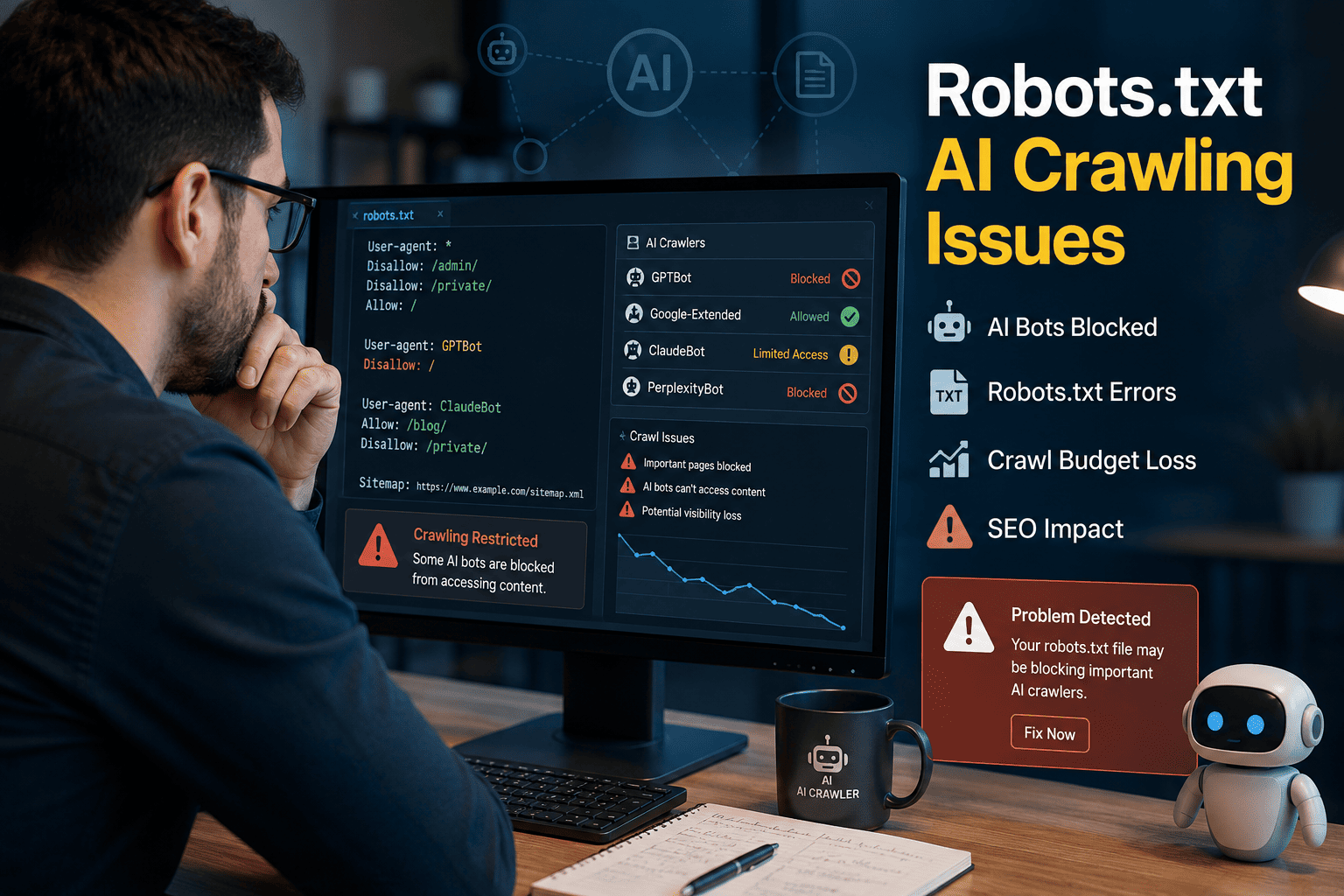
Introduction: The New AI Search Era
In 2026, the internet is no longer only driven by traditional search engines.
Search behavior has changed completely. Now, artificial intelligence systems also play a major role in how people find and consume information online.
These systems include:
- ChatGPT-based browsing systems
- Perplexity AI search engine
- Google AI Overviews
- Google Gemini systems
- Google Robots.txt Guide
Instead of only showing links, these systems read websites, understand content, and generate direct answers for users.
To do this, they use automated programs called robots.txt allow GPTBot PerplexityBot Google-Extended guide
.
These bots visit websites and collect publicly available information.
⚠️ Important SEO Reality
Robots.txt is NOT a ranking factor.
It does NOT increase traffic.
It does NOT guarantee visibility in AI systems.
Its only function is:
👉 controlling which bots are allowed or blocked from accessing a website
If bots are blocked, AI systems may not be able to read or understand your content.
What is Robots.txt? (Simple and Clear Explanation)
Robots.txt is a simple text file placed in the root directory of a website.
Example:
📌 Purpose of Robots.txt
Robots.txt is used to:
- Allow or block search engine bots
- Control crawling behavior
- Guide AI crawlers and search engines
📌 Simple Example
User-agent: *
Disallow: /admin/
👉 Meaning:
“All bots are not allowed to access the admin folder.”
📌 Important Note
- Robots.txt is publicly visible
- It is not a security tool
- It only provides instructions to bots
- It does not protect sensitive data
🌐 Why AI Crawlers Matter in 2026
Artificial intelligence has changed how users interact with search engines.
Instead of clicking multiple websites, users now receive direct answers from AI systems.
These systems:
- read web pages
- understand meaning
- extract useful information
- generate summarized responses
Because of this shift, website owners now focus on:
👉 AI visibility (also known as GEO – Generative Engine Optimization)
Main AI Crawlers in 2026 (Detailed Explanation)
1. GPTBot (OpenAI)
GPTBot is an official crawler used by OpenAI systems.
📌 Function:
- Reads publicly available web content
- Helps improve AI understanding of information
- Supports model knowledge systems
Important Reality:
Allowing GPTBot means:
✔ Your content can be accessed
❌ It does NOT guarantee ranking in ChatGPT
❌ It does NOT guarantee citations in AI responses
👉 It only provides access, not visibility assurance.
2. PerplexityBot
PerplexityBot is used by the Perplexity AI search engine.
📌 Function:
- Crawls websites in real time
- Extracts information for AI-generated answers
- Provides source-based responses
📌 If Allowed:
✔ Better chances of AI visibility
✔ Content can appear in AI answers
📌 If Blocked:
❌ Reduced AI search presence
❌ Content may not be included in answers
3. Google-Extended
Google-Extended is used for Google AI systems.
📌 Function:
- Supports AI Overviews
- Supports Gemini AI features
⚠️ Important Clarification:
✔ It does NOT affect traditional Google ranking
✔ It only controls AI-based features
Common Robots.txt Mistakes (Critical SEO Issues)
Many websites lose traffic due to incorrect configuration.
1. Blocking the entire website
User-agent: *
Disallow: /
👉 Result:
The entire website becomes inaccessible to bots.
2. Blocking blog directories
Disallow: /blog/
👉 Result:
Blog content cannot be crawled or indexed properly.
3. Ignoring AI crawlers
Many websites only configure Googlebot and ignore AI bots.
👉 Result:
Loss of AI-based traffic and visibility.
4. Over-blocking dynamic URLs
Disallow: /*?*
👉 Result:
Important dynamic pages become inaccessible.
How to Fix Robots.txt (Professional Step-by-Step Guide)
Step 1: Open Robots.txt File
If it does not exist, create it in your root directory.
Step 2: Allow AI Crawlers
User-agent: GPTBot
Allow: /
User-agent: PerplexityBot
Allow: /
User-agent: Google-Extended
Allow: /
Step 3: Fully Optimized Robots.txt
User-agent: *
# Private sections
Disallow: /admin/
Disallow: /login/
Disallow: /dashboard/
Disallow: /api/
# Public content
Allow: /blog/
Allow: /articles/
# AI Crawlers
User-agent: GPTBot
Allow: /
User-agent: PerplexityBot
Allow: /
User-agent: Google-Extended
Allow: /
# Sitemap location
Sitemap: https://yourdomain.com/sitemap.xml
What is the Crawl Budget? (Advanced SEO Concept)
Search engines and AI crawlers do not visit all pages equally.
They have a limited capacity called:
👉 Crawl Budget
📌 Factors affecting crawl budget:
- Website speed
- Server performance
- Number of pages
- Duplicate content
- Internal linking structure
How to Improve Crawl Budget
To improve crawling efficiency:
✔ Remove duplicate pages
✔ Fix broken links
✔ Improve website speed
✔ Use strong internal linking
✔ Avoid thin or low-quality content
Cloudflare and AI Bot Management
If you use Cloudflare, proper configuration is very important.
📌 Key settings:
- Review firewall rules carefully
- Ensure AI bots are not blocked
- Allow GPTBot access
- Allow PerplexityBot access
- Monitor bot traffic regularly
Common Mistake:
Blocking all bots in firewall settings.
👉 This can block both SEO and AI traffic completely.
How to Track AI Bots
You can monitor AI crawler activity using:
1. Server Logs
Check for:
- GPTBot
- PerplexityBot
- Google-Extended
2. Hosting Control Panel
Most hosting providers show bot activity logs.
3. Cloudflare Analytics
Provides detailed reports on bot traffic behavior.
Real Case Study (Practical Example)
Situation:
A website accidentally blocked all bots in robots.txt.
Problem:
- GPTBot blocked
- PerplexityBot blocked
- Google-Extended blocked
Results:
- Zero AI traffic
- No AI citations
- Reduced organic visibility
Solution:
- Updated robots.txt file
- Allowed AI crawlers
After 30 Days:
- AI visibility improved
- Perplexity citations appeared
- Crawl activity increased
👉 Key Lesson:
Even a small robots.txt mistake can significantly affect AI visibility.
Robots.txt vs Noindex (Important SEO Comparison)
| Feature | Robots.txt | Noindex |
| Crawling | Block or allow | Allows crawling |
| Indexing | Indirect control | Direct control |
| SEO Impact | Low | High |
AI SEO Strategy (GEO Optimization)
To improve AI visibility, follow these principles:
1. Structured Content
- Clear headings
- Short paragraphs
- Simple and readable language
2. Semantic Writing
AI prefers:
- Natural language
- Question-based answers
- Clear explanations
3. Authority Building
- Internal linking
- External references
- Regular updates
4. Sitemap Optimization
Sitemap: https://yourdomain.com/sitemap.xml
Important SEO Truth
- Robots.txt does NOT improve ranking
- It does NOT guarantee traffic
- AI systems decide visibility
- Content quality is the most important ranking factor
Future of Robots.txt (2026 and Beyond)
Robots.txt is evolving into a more advanced system:
👉 AI Access Control Layer
Future possibilities:
- AI training permissions
- Content licensing control
- Monetization rules for AI scraping
- Selective AI access control
FAQs (SEO Optimized)
1. Does GPTBot improve ranking?
No. It only provides access.
2. Should I allow PerplexityBot?
Yes, if you want AI visibility.
3. Does Google-Extended affect SEO?
No, it only affects AI features.
4. Can AI bots harm websites?
No, they only read public content.
5. Is robots.txt enough for SEO?
No, it is only one part of SEO.
Final Conclusion
Robots.txt is an important technical file in modern SEO.
However:
👉 It does NOT control ranking
👉 It only controls access
👉 AI systems decide visibility
👉 Content quality is the most important factor